
Venus to make its first ‘transit’ between Earth, sun since 1882
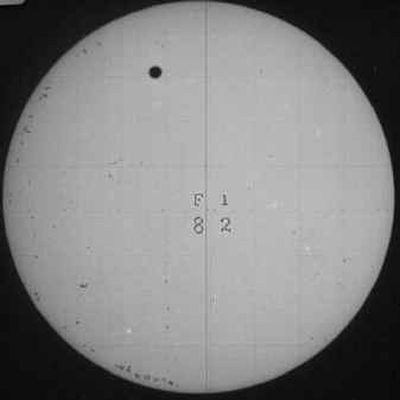
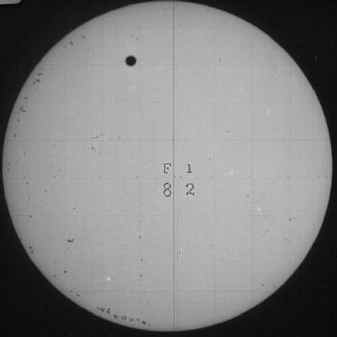
What a difference 121.5 years make. The last time the planet Venus passed directly between the sun and Earth – in 1882 – the Great Powers, as well as upstarts such as the United States, sent scientific teams to the far corners of the globe to observe the event.
Their aim: use the “transit of Venus” to compute the exact distance from Earth to the sun, a problem that had captivated astronomers ever since Aristarchus of Samos made a wildly inaccurate calculation 2,300 years ago. (He did determine – quite accurately — that the sun was a long way away.)
In 1882, said NASA Chief Historian Steven Dick, “the excitement could be compared to the space race. Any country with an interest in its scientific reputation was involved. It was the thing to do in the 19th century.”
Next Tuesday, it happens again. And although astronomers long ago found much better ways of calculating the astronomical unit – the Earth-to-sun distance, which is reckoned today at 92,955,887.6 miles – the transit remains an event of great rarity and curiosity.
In the United States, only the last two hours of the six-hour transit will be visible — and that only in the eastern part of the country, just after dawn. Much of Europe, Africa and Asia, however, will see it all, and astronomy aficionados have mounted numerous expeditions to prime observation spots.
The transit will be visible to the naked eye, but experts caution that looking directly at the sun will cause permanent damage to the eyes. The solution is to project the image with a “pinhole camera” device or to look through a dark filter, either with the eyes alone or with a telescope or binoculars. (For instructions on safely viewing objects crossing the sun, see the Web site skyandtelescope.com/observing/objects/eclipses.)
What observers will see is an unusual alignment of the heavens – when the geometry of space contrives to put Earth, Venus and the sun all in a row. Observers on Earth will see Venus as a small black dot crossing the face of the sun, like a bug walking across a light bulb.
The great German astronomer Johannes Kepler was the first to predict a transit of Venus – the one in 1631 – but he died the year before it occurred. But the next transit – in 1639 – was both predicted and witnessed by a young British cleric, Jeremiah Horrocks, the first person known to have observed the phenomenon.
The variable interval between transits – eight years, 121.5 years, eight years, 105.5 years – occurs because Venus orbits the sun more rapidly than does Earth and because the two planets’ orbits depart from the same plane by 3.39 degrees. Most times when Venus passes between Earth and sun, Earth is either too “high” or too “low” for the transit to occur.
Kepler and Horrocks had conducted what at first seemed like little more than an interesting exercise for that ever-more-popular new tool, the telescope. But in 1716, the British astronomer Edmond Halley, of Halley’s comet fame, had a more ambitious idea: by tracking Venus during its transit, astronomers could accurately compute the distance from Earth to the sun.