
Making jazz cool

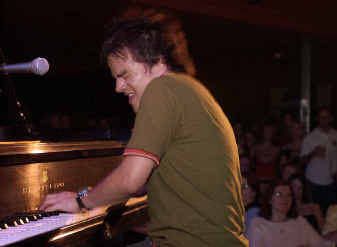
MTV rarely covers jazz, but Jamie Cullum is a different story.
A recent MTV News segment included an enthusiastic thumbs-up from superproducer Pharrell Williams. He was so blown away by Cullum’s jazz version of his hip-hop hit “Frontin’ ” that he pronounced the 24-year-old singer-pianist “definitely our kind of people.”
In his native Britain, Cullum has enjoyed unexpected, Norah Jones-like success with his major label debut, “Twentysomething.” It’s sold more than 1 million copies since its October release, making Cullum the top-selling British jazz artist ever.
Cullum, who infuses his jazz with punk, heavy metal and hip-hop influences, now has invaded America with a resequenced version of “Twentysomething” and a monthlong tour. The CD has climbed to No. 2 on Billboard’s contemporary jazz chart, behind Jones’ “Feels Like Home.”
While Cullum and Jones both cross genres and generations, “the only similarities are the fact that we both play piano and we sing,” he says.
Jones is subtle and introverted, a well-schooled musician who blends jazz with soul, country, blues and folk. Cullum is precocious, extroverted, largely self-taught — and in love with pop music.
“When I play jazz, I try to imbue that kind of urgency and edginess of pop,” Cullum says.
“I can pull from so many camps when I’m playing jazz … from rock ‘n’ roll, pop, hip-hop, dance and classical. When I was playing rock ‘n’ roll, it was much more rigid. … In jazz, I can be different every night.”
His music isn’t the only thing that sets Cullum apart from retro, suit-wearing young jazz crooners like Peter Cincotti or Michael Buble. He shows up for an interview wearing a T-shirt, paint-speckled blue jeans and scruffy sneakers — similar to what he wears on stage. Cullum says he gets so hot and sweaty while performing, he’d feel “too encumbered” in a suit.
Cullum’s CD hardly captures the excitement of his live performances. He’s energetic, feisty, risky, a 5-foot-4 bantamweight with spiky brown hair and the attitude of a punk rocker or hip-hopper.
He opened a May set at Joe’s Pub in Greenwich Village standing on top of the piano as he launched into his opening number, Cole Porter’s “I Get a Kick Out Of You.” He then stood at the piano, pounding out the melody and slamming the keyboard with his foot to accentuate the word “kick.”
On “I Could Have Danced All Night,” he slapped out the beat on the wooden piano frame and played inside the piano, turning the old standard into funky house music. Later, he put a jazz spin on rock and pop hits such as Radiohead’s “High and Dry” and Jimi Hendrix’s “Wind Cries Mary.”
Cullum, who played in grunge and hip-hop bands as a teenager, says he discovered jazz through the “back door.”
Listening to heavy metal, he found himself drawn to the guitar solos, which led him to jazz instrumental solos. Then he discovered the jazz samples used by hip-hop bands such as A Tribe Called Quest and Public Enemy. As he got into songwriting, he found his role models such as Bob Dylan and Tom Waits talking about George Gershwin and Porter.
He may be shaking up the jazz scene, but in some ways Cullum is a throwback to an older generation of jazz musicians who saw themselves as entertainers and embraced the popular music of their day.
“Jazz used to be about dancing, drinking and girls, but the first time I went to a jazz club all I saw were old men and no girls,” says Cullum. “So what does a 17-year-old make of that?
“I’m not trying to change jazz,” he says. “I’m just trying to make music that I feel comfortable with … and that I could relate to as a young man. Jazz is beautiful, melodic, catchy, cool music and it can be popular if it’s just presented in a way that doesn’t always try to pretend it’s better than everything else.”