
Manufacturing good will
WENATCHEE, Wash. — The gritty sweat-and-work ethic that helped power Alcoa’s Wenatchee Works plant has not been wasted in the nearly three years the smelter has been idle.
Instead of making aluminum, about 300 Alcoa employees have put in more than 100,000 hours of community service work. More than 150 nonprofit agencies, schools and governments have benefited.
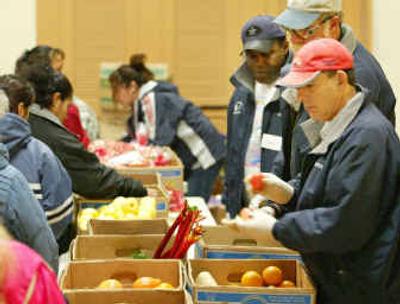
Alcoa workers have built park restrooms and retaining walls, planted trees and flowers, taught in schools, served food to the needy, painted offices, maintained Little League baseball fields, cleaned fire hydrants and installed computer servers.
“I’ve seen evidence of their work just about everywhere in the nonprofit community,” said James Benham, executive director of Mission Vista Inc., an agency that operates two residential facilities for the developmentally disabled.
Alcoa is essentially subsidizing the work. Under a deal with the Chelan County PUD, the utility is selling Alcoa’s share of power produced at Rocky Reach Dam in exchange for the company guaranteeing jobs at the plant. Since the employees are still collecting a paycheck, they must either show up to do maintenance or other work at the smelter or community service work, said Alcoa spokesman Jim Baxter.
The program may be the only one of its kind in the country — perhaps ever.
Stephen Jordan, director of the U.S. Chamber of Commerce’s Center for Corporate Citizenship, said he has never heard of such a large-scale corporate community service effort. Some large corporations allow as many as a dozen employees to work for nonprofit groups for up to one year and still collect a paycheck. Alcoa’s program goes way beyond that, he said.
“It’s pretty remarkable,” Jordan said from his Washington, D.C., office.
Some, like Benham, have likened Alcoa’s campaign to a smaller version of the Civilian Conservation Corps (CCC). The Great Depression-era relief program put 3 million able-bodied, but unemployed, men to work constructing thousands of roads, parks, bridges, trails and ranger stations.
Like the CCC projects, the public benefits from the work done by Alcoa employees. The government agencies, nonprofit groups and schools have not paid for any of the work.
Jo Keyser, president of the Wenatchee Aluminum Trades Council, the umbrella organization for the Alcoa plant’s five unions, said union members have enjoyed the community work.
“Every one of them that goes out there absolutely loves it,” Keyser said. “It’s helping us learn more about the community.”
The arrangement is a “very creative way” for Alcoa to keep its trained work force intact and do public good, said William Basl, executive director of the state Commission on National and Community Service, which oversees the AmeriCorps program in this state.
Both Alcoa and the PUD deserve credit for reaching a deal at a time when it looked like the aluminum plant would close and all workers would be laid off, said Dianne Cornell, executive director of the United Way of Chelan and Douglas Counties.
“They were certainly able to make lemonade out of lemons,” Cornell said. “Instead of sitting back and waiting for something to happen, they mobilized and were able to make a positive out of a negative.”
Benham said Alcoa employees aren’t simply extra muscle and hands to throw at projects, but instead a skilled work force. A retaining wall they built at a residential home was professional-quality work, he said.
“These are multi-talented people with skills ranging from drywall to concrete to electrical work,” he said. “It’s obvious that they bring a lot of skills to this community.”
Not all the jobs Alcoans have tackled, though, involve skill. Some projects also have been of the back-breaking variety.
Nick Fox, a Stemilt Irrigation District board member, said Alcoa workers spent three months last summer clearing trees and bushes along the Lily Lake dam face and equalization reservoir. Anywhere from two to eight people volunteered on any given day, he said. The work also included clearing and cutting brush along more than three miles of system pipeline.
“Those guys volunteered for very physical, very hard work,” Fox said. “You couldn’t believe they were volunteers for as hard as they worked. I have nothing but praise for them.”
At Ohme Gardens County Park north of Wenatchee, Alcoa workers did nursery work, planted new vegetation and made signs last year, said Mike Short, garden administrator. As many as a dozen volunteers showed up on some days to do work the park could not afford to pay for, he said.
“With those volunteers, we saved a couple of years worth of work,” Short said. “It was stuff that was going to get done eventually, but it would have been a while before we got around to it. It was invaluable.”
When Kenroy Elementary School in East Wenatchee had two volunteers last school year, Principal Bob Busk put them to work in first-grade classrooms.
“We didn’t want to use them to install things or do maintenance,” he said. “We asked them to listen to kids read, help kids practice their math and lend a hand with art projects.”
Of course, the service work done by Alcoa employees would not have been accomplished if the Wenatchee Works plant was still producing aluminum ingots.
What happens if and when the plant restarts or shuts down permanently?
“When we get called to start making aluminum again, the paint brushes get put down almost immediately and people go back to work making aluminum,” Baxter said. “But I don’t think the community service will stop entirely. There are (Alcoa) people who are being paid right now to do that service work, but you find some of them out there working on Saturdays. They’re not getting paid a nickel to do it, but they’re out there doing it.”