
A race against time for Buchanan
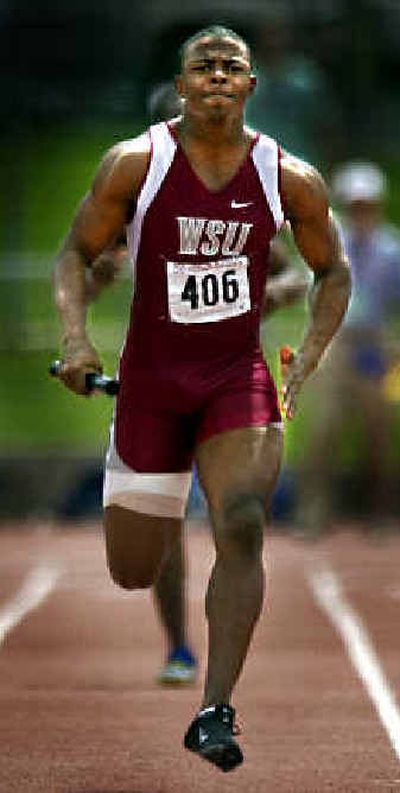
The only distance Anthony Buchanan covers more quickly than 100 meters is the gap between expectation and doubt – or doubt and expectation, if you prefer.
Spokane’s fastest human settles into the blocks for that dash one last time this weekend, his track career at Washington State University coming to an end at the NCAA championships in Austin, Texas, where he is either The Great Cold-Weather Hope or The Sprinter Most Likely to Self-Destruct.
Fast or famine, that’s Anthony. And he knows it.
“I don’t understand myself sometimes,” he said, the hint of a laugh punctuating the sentence.
He is coming off a second straight Pacific-10 Conference title in the 100 – the first sprinter to pull that off since it was accomplished in the mid-1990s by UCLA’s Ato Bolden, who is only the fastest collegian in history. In doing so, he ran a legit 10.21 – only two sprinters from this state have ever run faster – and last year put up a wind-aided 10.10 in the same meet.
“Anthony is fast, pure and simple,” said his WSU coach, Rick Sloan. “He’s one of the eight fastest guys in the country when they get there on the same day.”
But that’s the problem – he can’t seem to get there.
Though he has won some big races – the Pac-10s and Texas Relays, for example – he has never made the finals at the NCAAs in any event nor reached his goal of being an All-American, and he’s limped away from or scratched himself out of more races than he cares to remember.
“Every time I get there,” he said, “something seems to drag me down.”
And yet always he returns to pull himself up the next year, if not conventionally or without some bizarre hiccups.
Take this year. By most accounts, Buchanan did his most diligent fall training ever in preparation for his final season as a Cougar, determined to minimize the hamstring trouble that had plagued him the previous two years and build an unshakeable base. But unfortunately, he hadn’t done the same preparation in the classroom – taking an incomplete the previous spring that required a full course retake and keeping him out of a WSU uniform until the dual with rival Washington on May 1.
A line of thought emerged that the limited racing – he ran in a couple of meets unattached before the Husky meet – actually may have protected his fickle hams from too much stress, and his performance at Pac-10s didn’t anything to puncture the balloon. But then it stiffened after the prelims of the NCAA regional 100 two weeks later, and while he did manage to anchor the Cougars’ 4x100 relay through the national qualifying process, he wound up seventh in the 100 and qualified for this week’s meet only because of his high placement on the at-large list.
Now he professes himself whole again – but the workload is again a worry.
The Cougars must run a relay prelim in today’s opening session. Then Buchanan must get through both the prelims and semifinals of the 100, and as Sloan said, “The bad thing is, you don’t have the opportunity to run easy in any of those rounds. If the relay’s going to make it, we have to put him in a competitive position – we’re going to have to try and win the heat.”
On the other hand, the Cougs may never have seen Buchanan this motivated. The singular disappointment in his WSU career has been his inability to perform at nationals.
“They”ve been good here about never putting too much pressure on me and letting me develop as a sprinter,” Buchanan said. “I put more pressure on myself than anybody else does. The first two years here, I just wanted to get better, but there have been some things I wanted to accomplish that I haven’t been able to and I’ve only got this one last chance.”
His achievements at University High School certainly preceded Buchanan to Pullman four years ago, and Sloan only needed one look at the bullet-built blazer to understand what he had.
“We watched him run the 55 meters indoors unattached at a meet in Cheney when he was in high school,” Sloan recalled, “and all we had to do was see him come out of the blocks and accelerate to know he was extremely talented. He was well-coached and had good mechanics, good position coming out of the blocks – he just knew how to run – and we thought, ‘Man, this guy’s good.’
“Even now, what he’s able to do on limited training and natural talent – he’s so powerful and explosive, it’s amazing.”
Yet when he arrived at WSU he had to earn a resume – matched as he was with Anson Henry, who would eventually set the school 100 and 200 records and figures to be running in the Olympics this summer for his native Canada, and Texan Bennie Chatman, who liked to call himself Da Jett. Even now, as much as he savors his Pac-10 two-peat, Buchanan loves to recall leading a 1-2-3 Cougar sweep of the 100 at the Texas Relays and a meet official telling him, “You Washington boys aren’t supposed to beat our Texas boys.”
“That was just so great,” he said.
But that was the last time Buchanan excelled on a national stage. And while it’s been a source of frustration for him, it’s been shared by those who have expected true greatness and wonder if he’s taken his gift as seriously as he should – which, of course, is a question only Buchanan can answer. It’s easy for an outsider to cast doubts on a runner’s motivation, dedication, courage, focus – any of it – when he’s not the guy hurtling down the track.
Buchanan knows he sends out some mixed signals. Take the pre-race gamesmanship traditional to the 100.
“Most guys you see are all scowling and hard,” he said. “If people saw me on the track, I’m walking around talking to people, saying good luck, smiling. They say, ‘How come you’re not focused?’ but I am – I just do it in a different way.”
And it’s easy to come away with the impression that doing things differently is almost as important to Anthony Buchanan as running fast.
“Even in high school,” he said, “I’d tell people, ‘I’m a mystery.’ People can’t figure me out and I kind of like that about myself. I don’t want to be a normal, average guy. I want people to guess about every step I take.” self end