
Reagan religion
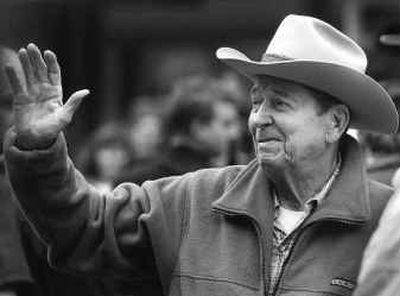
Ronald Reagan had a religious faith “deeper than most people knew,” evangelist Billy Graham observed soon after news broke of the former president’s death.
But what was the shape and substance of that faith?
The question got full scholarly treatment just a few months ago in a book by Reagan admirer and Grove City (Pa.) College political scientist Paul Kengor in a book titled “God and Ronald Reagan: A Spiritual Life” (ReganBooks).
But even Kengor’s meticulous research didn’t remove all ambiguities. Reagan’s spiritual side remains somewhat elusive beyond what seems to have been a sincere, sturdy and nondenominational faith in Jesus.
“While he was president, Ronald Reagan’s religious faith was, at best, dismissed or ridiculed,” Kengor summarized. “For me personally it has been a moving experience to discover, and help bring to light, this overlooked side of the historical Reagan — a side he would have wanted to be recognized.”
Kengor “gets it right,” said son Michael Reagan, a conservative radio talk show host.
If for no other reason, Reagan will always be a religiously fascinating American leader because, in 1980, he snatched scads of churchgoers’ votes as he defeated incumbent Jimmy Carter, one of the most devotedly Christian U.S. presidents of the past century.
Reagan cultivated evangelicals, and he shared their views and instincts on many social issues, including abortion, which he opposed. Since then, white conservative evangelicals have been perhaps the most loyal segment of the Republicans’ nationwide coalition.
Religious references were a continual thread in Reagan’s words, in public and in private. Among Kengor’s inside sources were close aides Richard Allen, Edwin Meese and William Clark, described by Kengor as the president’s “closest prayer partner.”
Another private glimpse provided by Kengor: The night Reagan returned to the White House after nearly being shot to death, he confided in his diary, “Whatever happens now I owe my life to God and will serve him every way I can.”
Reagan similarly told New York’s Roman Catholic cardinal at the time, Terence Cooke, “I have decided that whatever time I have left is for him,” according to biographer Edmund Morris.
Kengor sees strong religious roots in Reagan’s profound anti-communism, underscored by the president’s famous speech to the 1983 National Association of Evangelicals convention.
There, Reagan said Soviet leaders were “the focus of evil in the modern world,” warning against the “temptation” to “ignore the facts of history and the aggressive impulses of an evil empire” and promote peace without considering moral matters of right and wrong.
The moral absolutism came from Reagan’s spiritual beliefs, Kengor contends, though he borrowed the “evil empire” phrase from France’s chief of intelligence and the concept of concentrated world evil from Whittaker Chambers and Alexander Solzhenitsyn.
Kengor also provides insights regarding Reagan’s upbringing in the Christian Church (Disciples of Christ) in Dixon, Ill. In this and much else, his devoutly Protestant mother Nelle was far more influential than father Jack, a Roman Catholic with a drinking problem.
Baptized into the Disciples of Christ at age 11, Reagan was an active church lad in his teens, teaching Sunday school and dating the preacher’s daughter. The pattern of devotion seemingly continued at Eureka College, a Disciples of Christ school, and at Beverly Christian Church during Reagan’s early years in Hollywood.
Less is known about Reagan’s religious habits as a mature adult, though Kengor argues convincingly that the president shied away from churchgoing while in office due to the assassination attempt.
After the White House years, Reagan “resumed regular attendance” at church, Meese told Kengor, but his research provides little information on Reagan and religion after 1989.
Reagan had long since drifted from the Disciples to identify with Bel Air Presbyterian Church, a prominent evangelical congregation in Los Angeles. At one time, that had been planned as his funeral site, but for logistical reasons its retired pastor, Michael Wenning, instead led a family service Monday at the Reagan library.