
Exercise class designed for cancer patients
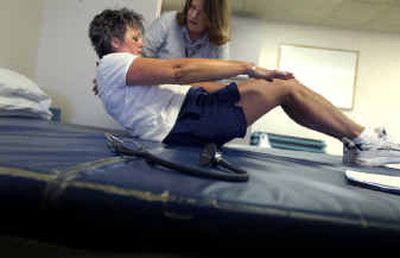
After her vacation, Kathy Murphy returned to her twice-a-week exercise class and the usual good-natured teasing and laughter.
“I exercised on vacation, I want you to know,” she protested.
The new class, designed specifically for cancer patients, has helped Murphy, 48, feel more like herself.
“I wanted to exercise, but a part of me was afraid of hurting myself in some way,” Murphy said. Almost three years after being diagnosed with breast cancer, Murphy felt intimidated by health clubs and worn out by chemotherapy, surgery and radiation. But she decided that working out with physical therapists who understand cancer treatment side effects was something she could do.
Her oncologist, Dr. Kawaljit Dinsa-Chester of Cancer Care Northwest, designed the program with help from St. Luke’s Rehabilitation Institute and Washington State University-Spokane. St. Luke’s specialists provide the instruction and monitoring. The class meets at St. Luke’s.
Studies have shown that exercise can improve quality of life and the ability to do daily tasks for people during and after cancer treatment. The new exercise program may add to that evidence. Participants’ progress will be tracked for a research study of how well the program works.
Piano teacher Mary Simpson, 52, has noticed improvement in her stamina, strength and balance since joining the program in January. She also enjoys sharing tips during class and hearing answers to questions such as: How long will it take for my hair to grow out? How long are my eyes going to water?
Like Murphy, Simpson is recovering from breast cancer. The class helps her build the endurance to walk up a flight of stairs without pausing every few steps and the strength to lift a stack of dishes onto a high shelf.
“They start you out very gently,” she said. “If you try to do too much or compete, they’re good at making you back down.”
The program has had 17 participants so far. More will be added thanks to a $62,000 grant from the Eastern Washington affiliate of the Susan G. Komen Breast Cancer Foundation.
Most health insurance plans don’t cover the class, although they do cover an initial evaluation. The class costs $90 for the first month, which includes blood pressure and heart rate monitoring. When a patient’s vital signs stabilize, usually between the second and the sixth month, the cost goes down to $72 per month. Later, the cost can fall again to $54 a month.
For information, call 473-6013.
Grant for health
Women covered by government health insurance, such as Medicaid, can get screened for cervical cancer without charge, but there is no state money for following up on abnormalities.
Planned Parenthood of the Inland Northwest recently announced receiving a $20,000 grant for its Cervical Health Program from Foundation Northwest, a regional foundation that awarded $1.5 million in grants last year.
The grant will provide colposcopies and lab work for women in financial need on a sliding scale based on family income. Based on last year’s numbers, Planned Parenthood expects to help 500 women in the program. (A colposcopy is a test used to examine the cervix for problems after an abnormal Pap smear. It’s sometimes combined with a biopsy in which tissue is sampled and examined for unusual cells.)
Cancer research talk
Dr. Stephen Anthony, research director of Cancer Care Northwest, will speak at 6 p.m. June 24 on cancer research and new drug development. He’ll discuss how local patients who participate in clinical trials play a role in research. The free lecture will take place at Cancer Care Northwest, 601 S. Sherman. To reserve a seat, call 747-4316 by next Tuesday.
Clinic relocating
The St. Luke’s Rehabilitation Institute outpatient clinic at Deaconess Medical Center is relocating its services to the St. Luke’s main campus, 711 S. Cowley. The move will be complete by the end of the month. The change does not affect St. Luke’s outpatient clinics at Indian Trail and Valley Hospital and Medical Center.