
Local man travels to D.C. for monument dedication
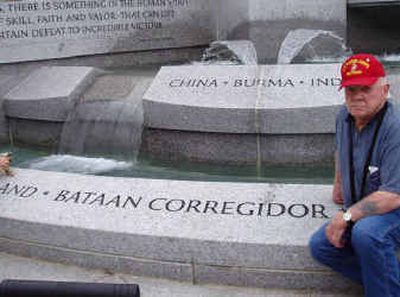
Corregidor is half a world away from Washington, D.C., but the Philippine island and our nation’s capital were linked on May 29, at least in the emotions of one 84-year-old Coeur d’Alene man.
Roy Weaver was a corporal, a three-year veteran of the Marine Corps, when on May 6, 1942, he was captured by Japanese soldiers at Fort Hughes, an island garrison off Corregidor.
Three-and-a-half years of captivity followed, first in the Philippines, then in Manchuria, before his camp at Mukden was liberated by Russian troops on Aug. 20, 1945.
Roy was discharged the following year but stayed in the Marine Corps Reserves and was recalled for the Korean War in 1950. This time he stayed in the service, and in 1964 he retired as a gunnery sergeant.
Our nation finally honored Roy Weaver and the thousands of other American veterans of World War II on May 29 with the dedication of a monument to them on the mall in Washington, D.C.
Weaver was there.
“We World War II POWs were right up front, the politicians in back,” he recounts. “I’d scoped out the situation and stayed about 20 rows behind the other POWs.”
Roy had guessed right. Just before President Bush arrived for his address, the Secret Service people “locked up” the first 10 to 15 rows.
“They couldn’t leave, not even to go to the bathroom, as long as the president was there,” Roy says.
His wife, Caroline, doesn’t like airplane travel, so the Weavers had journeyed to Washington on an Amtrak passenger train. They left Spokane on May 21 and, after two days and nights in coach seats, arrived in the nation’s capital. The following day, he hiked three miles to the memorial for a personal sneak preview.
The Weavers’ son, daughter-in-law and two granddaughters – who had traveled from their High Point N.C., home – joined them, and a member of U.S. Rep. Butch Otter’s staff treated the Weaver family to a private tour of the capitol building.
Roy and his wife were put up in the Sheraton Hotel in Arlington, Va., along with about 60 other former World War II prisoners and their families. He encountered one other man with whom he’d been imprisoned at Mukden. “His mind is pretty much gone,” Roy says. “He didn’t remember me.”
On dedication day, Roy and Caroline took the Sheraton shuttle to the Pentagon, then the former prisoners and their families transferred to “safe” buses that had been inspected by security personnel. They rode them to the memorial behind police sirens and flashing red lights.
The vets and their family members wore special identification cards on lanyards to ensure they’d receive appropriate seating and honors. The cards were issued by veterans’ organizations; without them they would have been denied VIP status.
“We heard from the president, Tom Hanks, Sen. Bob Dole, Tom Brokaw and former Marine Corps Commandant Gen. P.X. Kelley,” Roy says. “They were all good, especially Bob Dole. He has a great sense of humor.”
Roy guesses that the dedication was probably, “the biggest in history for a bunch of 85-year-olds,” and is fulsome in praise for the planning and execution of the event.
He says there were porta-potties aplenty; about 400,000 bottles of water were distributed; and volunteers with orange flags “like crossing guards carry” were stationed throughout the crowd.
“When a lady near us collapsed in the heat, a volunteer was right there, and he unfurled his flag and raised it. An EMT crew was on the scene in a minute.”
Roy admits to tears during the ceremony: “I was thinking that only about 15 percent of us who fought in that war are left, and a lot of them can’t travel any more. It’s a damn shame that the memorial didn’t come sooner so more guys could have seen it.”
The memorial itself, a pool surrounded by monuments depicting the Atlantic and Pacific Theaters, the states, territories, important battles and 1,000 stars – each representing 400 U.S. war dead – is below the line-of-sight from other prominent mall landmarks, such as the Lincoln Memorial, Roy says.
Richard Uliano of the CNN radio network interviewed Roy and several of his Coeur d’Alene friends heard him.
A group of high school youngsters spotted his red “U.S. Marine Corps Retired” baseball cap while he was visiting the Korean War memorial and also interviewed him. A pair of Chinese women overheard their conversation and had their photo taken with Roy.
The cap stood him in good stead throughout his stay in Washington, he says.
“Another marine came up and we gabbed, and folks who spotted me in restaurants and bars insisted on picking up some tabs,” he grins. “A couple of folks came up to me and said their fathers had been World War II marines. And everywhere we went, people couldn’t have been more friendly or helpful.”
Was the trip worth it?
Even weeks after the ceremony, this tough old marine can still tear up at the memory of the monument he shares with his fellow vets of that long-ago war: “It’s beautiful, and it’s ours,” he says.