
Conquering fathers
“Of all nature’s gifts to the human race,
what is sweeter to a man than his children?”
— Cicero
Fatherhood doesn’t begin in a classroom with a PowerPoint presentation. It usually begins in a hospital, when a man hears the words, “It’s a boy!” or “It’s a girl!” Or it begins when the adoption agency calls with life-changing news.
At that moment — without entrance exam or instruction booklet — a man assumes the new title, “daddy,” and a slew of uncharted responsibilities. All because of a wriggling baby who won’t say “thank you” for a long, long time.
Today, we look at five Inland Northwest fathers who have embraced fatherhood with resolve, endurance and a strong sense of faith. Though at times they feel bewildered and defeated, they are parenting with great intention, hoping that some part of their efforts will turn out right. Call it purposeful parenting, these dads are deliberate in their fatherhood goals.
Play like crazy
Raising healthy kids begins by providing a solid moral and spiritual foundation, said David Smith, of the Spokane Valley. Achieving this goal means spending lots of time with his son, Kodi, age 4, and daughter, Davis, age 2.
“When I come home from work, my son knows that after I talk to his mom for a few minutes, I’ll play like crazy with him,” said Smith, 28, a production manager at ServiceMaster. “We usually wrestle — like my dad did with me — or I’ll play hide and seek with both of them. The more time my kids spend with me, the more I’m able to model for them what I believe is important.”
Such values include showing grace, kindness and humility toward others; creating a hunger for lifelong learning; and excelling in their work.
“I want them to learn how to be a gentle friend,” Smith said.
Smith points to the day his first child was born as the defining moment of fatherhood.
“I was the perfect father until I had kids. I had all the right answers, and then reality hit when our first baby was born. I said, ‘Now it’s time to do this job.’
“Our life is about spending time together and having fun,” he said. “My kids will find other heroes as they get older but for now, dad is everything. Their problems are simple and they’re easy to teach, so I need to take advantage of the time I have.”
A shoulder to cry on
Cancer is a big word, but it was never as personal for Steve Nicholas as the day he sat down at the foot of his daughter’s bed to tell her she had Hodgkin’s lymphoma. That was five years ago. Susanne Nicholas was 15 and a freshman at Gonzaga Prep. They suspected something was wrong when she found a lump on her neck after returning home from a father-daughter dance.
After surgery, the diagnosis was confirmed.
“That day was a blur since we didn’t know much about cancer. The diagnosis changed the direction of our family’s life,” said Nicholas, 53, who works at Best Impressionz a promotional marketing firm.
As his daughter’s treatment began, Nicholas wrestled with unanswered questions: Why her?
“Being the macho idiot that I was, I thought I was in control,” he said. “I thought I could shoulder all of it. I was finally able to let go of the idea that I had control. We don’t have all the answers.”
Instead, Nicholas focused on the things he could provide Susanne, such as humor and a listening ear.
“I’m a jokester. I tried to make Susanne feel good by making her feel lighter … I learned a lot about girls. You can’t fix their problems, but they love to be listened to.”
Nicholas discovered that actions often speak louder than words.
“Susanne had long blond hair that sort of made her who she was in her eyes. To lose it was devastating. When she felt she wasn’t pretty anymore, there are no words to patch that up. I just let her eyes run, and her nose run on my shoulder and embraced her.”
At the same time, Nicholas was concerned that his younger daughter, Rachel, then 12, was feeling neglected.
“I found myself spending extra time with Rachel and it made our relationship better,” he said. “In a cliché, cancer was a gift wrapped in the ugliest package. The things that have grown out of it are things we cherish forever — my wife, Nancy; my faith; and the simple things in life.”
They are grateful their story has a happy ending. This summer will mark five years of Susanne’s remission. She celebrated with a college study abroad trip to Italy.
“Without her suffering, Susanne may not have grown spiritually as she has. That means a lot to her,” said Nicholas. “We try to hold every moment of every day sacred.”
Celebrating teen milestones
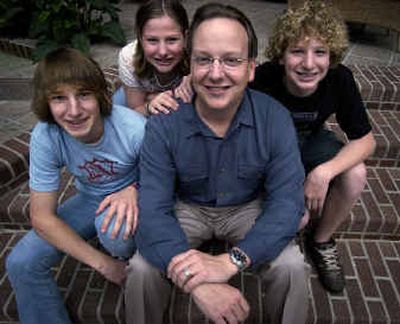
Ask Wayne Williams, of Liberty Lake, about raising adolescent children and he’ll point to three important milestones in a teen’s life — turning 13, 16, and 18 — around which he builds teachable moments. These birthdays are recognized culturally as coming-of-age markers, said Williams, 41, president of Telect. He goes one step further by commemorating them with personalized events for his children: Mitch, 17; Spencer 13; and Shayla, 10.
“Turning 13 is the beginning of adolescence, a pivotal time in a child’s life,” said Williams. “Age 16 is another milestone. In the eyes of the state, you are given a little more responsibility, in the form of a driver’s license. At 18, kids are released into adulthood. My job is to meet them at their milestone, give them direction, and show them what they can do to make good decisions.”
In the Williams family, turning 13 means taking a trip with dad. Williams took Mitch to the Rolex 24 Hours at Daytona car race. He surprised Spencer with a fly-fishing expedition in Canada.
“We stayed up late, ate junk food, and talked about girls,” said Williams, of those father/son trips. “You’re having the sex discussions, the boundaries discussions.”
By the time a child reaches 13, they have already been imprinted with their parents’ values, Williams said. After that, it’s time to bring influential people into their lives. When Mitch turned 16, Williams arranged for five men of Mitch’s choosing to come and speak to him about esteemed character traits of manhood. Each spent 30 minutes discussing honor, relationships, integrity, servanthood and trustworthiness.
“Mitch can still remember those talks,” said Williams. “I want people who (embody) those traits to be in his life. I want him to hear their stories. If he just heard it from dad, it would sound like ‘blah, blah, blah’. I will do the same for all of my kids.”
Williams is still considering how to commemorate his kids’ 18th birthdays. He knows it will include some intentional discussions about life — “what to avoid and what to keep your eyes on.”
“Being a father doesn’t get easier as they get older,” said Williams. “The older our kids get, the more they remind us of us. I am concerned that they become better people than I am.”
From Russia, with love
After 20 years of being married without children, and after a two-year adoption process, George Knapp felt prepared for the children he and his wife, Sandra Altshuler, were to bring home from Russia. Yet they could never plan for the range of emotions they felt that first day upon meeting Rena, 15 months, and Pavel, 10 months.
“We were so out of our element,” said Knapp, 54, a stay-at-home dad and part-time massage therapist. “We didn’t speak Russian; they didn’t speak English. After the long flight and a 15-hour train ride, we were shuttled to the orphanage. The kids were brought to us and we all met for the first time. When Rena saw me, she at once started to cry because she had never seen a man with a beard. After a few minutes, she stopped. From then on, she was daddy’s girl.”
The decision to adopt is one of the greatest choices of life, the choice to love a child, said Knapp, of Spokane. He and his wife decided that if they were to raise kids, he would stay at home with them and she would be the breadwinner, as a professor at Eastern Washington University.
“As a stay-at-home dad, the rewards are unbelievable; they go on and on,” said Knapp. “I wake up with them, spend my day with them. I teach them lessons from life; it gives me opportunities we’ll never have again.”
Now 5-year-olds, the children recollect their life in Russia by looking at photos and hearing their adoption story.
“A big part of international adoption is trying to maintain a connection to their culture. We wanted to retain their given names as much as possible, but also give them names chosen by us.”
They named Rena after Altshuler’s grandmother, and kept the Russian name as her middle name. Pavel was his given name, though they call him Pavi, “which is a little more Jewish,” said Knapp.
Their Jewish religion is an important part of the family’s fabric. On Friday evenings they celebrate Shabbat with candles, prayers and dinner. They attend family services and Sunday school at the temple.
“It was a defining moment when, in Russia, we were in court and the judge wanted to know how we were going to raise the children. I told her that the great thing about the Jewish religion is that family is at its core.”
In addition to celebrating religious holidays, the Knapps celebrate Adoption Day. Mostly, their time is spent at home reading, playing and learning together.
“My most important role is to be a little of everything for Rena and Pavi,” said Knapp. “I try to be part of their world, to be excited about the things they are excited about.”
How good do you want to be?
When Nick Westerberg of Greenacres played college football, he was used to being on the field running plays and taking hits. Now, as father to Ashley, 20, and Emily, 19, he is happy to stand on the sidelines, cheering on his daughters.
“My role is to be the best cheerleader that I can be,” said Westerberg, 45, a manager at Paramount Supplies.
When the girls were little, Westerberg thought he was relegated to being a “girly-girl dad.”
“We played tea parties; we didn’t play with balls,” he said.
It wasn’t until the girls got into third and fourth grade that they became interested in sports. Westerberg was thrilled.
“I realized I can have fun on the field with these dainty, beautiful young women.”
Ashley and Emily played soccer, softball, volleyball and basketball. For nearly a decade, Westerberg coached their teams and worked to instill confidence in his daughters.
“The time that I got to spend with both girls is time I would never give up. We would talk before practice and after practice. We shared wins and losses. Any time you spend with your young ones can’t help but bring you closer. It allows you to open yourself up and be real.”
Westerberg helped his daughters discover their passions, whether in sports or elsewhere.
“I taught my girls to believe in the skills and talents they have, that God has blessed them with. I asked them, ‘How good do you want to be?’ After all the practice, you have to believe in yourself.”
In high school, Ashley joined choir, tennis, and Leadership Spokane. Now she studies broadcast journalism as a senior at Washington State University.
“I see in Ashley a love for her friends and family,” said Westerberg. “She’s a political activist and president of her sorority. She’s Emily’s biggest fan.”
Emily pursued basketball and became an all-star player and leading scorer at Central Valley High school. She just finished her first year playing for Arizona State University.
Westerberg recalls telling Emily, ‘You’ve got the skills. The last little piece has to come from within you.’
“As parents, we are flight instructors,” he said. “Every child has the ability to fly at a certain altitude. We are to make them believe that they can attain an altitude beyond what they think they are capable of. That’s what our job is.”