
Bridge

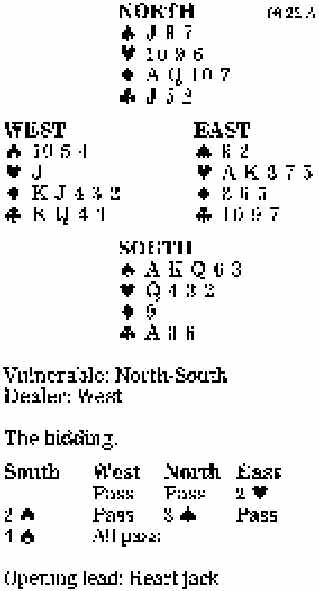
Even more important than watching partner’s cards is drawing the right conclusions from them. For example, on today’s deal, you lead your singleton heart against four spades. Partner wins the king, cashes the ace, and plays back the seven, declarer contributing the two, three and four.
It looks as if your partner opened two hearts with a five-card suit, not totally unreasonable in this position at favorable vulnerability. On the third round of hearts the card that he led to you to give you your ruff was his middle card (you know he has the eight and five left), so the implication is that he has no preference for one minor over the other.
You are now in a position to count declarer’s tricks: five spades, one heart, one club and at least two diamonds. His only potential additional source of tricks is the diamond suit. If South has more than a singleton diamond, he can always make three diamond tricks by way of two finesses, and you can tell that this would be his only practical line of play.
In fact, if you exit passively with a trump or a top club, South will surely take his diamond finesses or just run his black-suit winners and squeeze you till the pips squeak. Your only chance is that South has a singleton diamond. If so, you must switch to a diamond now, to avoid being mangled in the minors later on. That play destroys declarer’s communications for the squeeze.
Bid with the aces
South holds:
| •10 5 4 | |
| •J | |
| •K J 4 3 2 | |
| •K Q 4 3 |
| South | West | North | East |
| 1 • | |||
| Pass | 2 • | Pass | Pass |
| ? |
Answer: Reopen with a call of two no-trump to show the minors. You have the shape and the values to want to try to play a minor or to push the opponents up a level. Partner must be relatively short in spades, so your side ought to have a fit somewhere.