
Talks begin on Kashmir difficulties
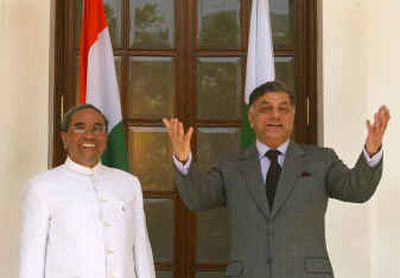
NEW DELHI — Nuclear-armed neighbors India and Pakistan eased into talks Sunday about one of the world’s most dangerous flashpoints — Kashmir — by first broaching confidence-building measures and the opening of a bus service across the cease-fire line.
Pakistani Foreign Secretary Riaz Khokhar and his Indian counterpart, Shashank, who uses one name, also discussed a proposed hot line for nuclear-related matters and reopening consulates in Bombay, India, and Karachi, Pakistan, during their four-hour meeting, a spokesman said.
“There were no difficulties. There was a flow of communication,” Pakistani Foreign Ministry spokesman Masood Khan said. “The intention is to make this exercise result-oriented.”
The two sides were to continue the talks — the most substantive on Kashmir in six years — on Monday.
Sunday’s talks also included the possibility of letting a bus carry Kashmiris across the cease-fire line that divides their homeland, Khan said.
The two countries — which have fought two full-scale wars over Kashmir and narrowly avoided another conflict in 2002 — have resumed cross-border bus, rail and plane services as part of peace efforts.
However, no bus has run between Srinagar and Muzaffarabad, the capitals of the Indian- and Pakistani-controlled portions of Kashmir, for nearly 60 years. The highway was cut off and tens of thousands of families separated in 1947, when India was partitioned to create Pakistan.
A new set of peace proposals was under consideration, Khan said without giving details, adding that a joint statement was likely.
Khan said the foreign secretaries “will come up with a calendar of meetings for talks at other levels,” aiming for an eventual summit between the nations’ leaders.
The next major step will be a meeting of the foreign ministers — a step above the secretary level — in August, he said.
India accuses Pakistan of training, arming and funding Islamic militants, who have fought Indian security forces since 1989 to win independence for Indian Kashmir or its merger with Muslim-dominated Pakistan. Pakistan denies the allegation, which is a key source of rancor.
In a sign of the difficult discussions ahead, Khan said what the Indian representatives least want to hear in such talks — that Kashmiris have to be included in the dialogue.
“Kashmiris are the principal party to the dispute. A viable, just solution has to be based on the wishes of the Kashmiri people,” Khan said.
New Delhi calls the rebels “terrorists,” rejects calls for a referendum on the issue and says it is an internal matter which will not be part of three-way talks with Pakistan.
Last November, the two sides agreed to a cease-fire along the Line of Control, which divides Kashmir.
India says Islamic insurgents still cross from Pakistan-controlled Kashmir into Indian territory to commit terrorist acts.
Pakistan says it doesn’t allow terrorists on its soil but acknowledges giving political and diplomatic support to what it calls Kashmiri freedom fighters. More than 65,000 people, mostly Muslim civilians, have been killed in the fighting.
Asked at a news conference whether Pakistan had explained to India the reasons for continued infiltrations, Khan said, “We owe an explanation to nobody. We don’t give explanations.”
The main Hezb-ul Mujahedeen militant group, which is based in Pakistan, welcomed the talks but said rebel attacks would not stop.
“It is good that Pakistan and India have started talking directly about Kashmir,” the group’s spokesman, Salim Hashmi, told the Associated Press from an undisclosed location in Pakistan. “Mujahedeen are continuing their activities in Indian Kashmir. … Armed struggle is going along. There should be no condition for it to stop for the talks.”
Khokhar also met pro-independence Kashmiri leaders from Indian-held Kashmir on Saturday and Sunday.