
Plants and pets
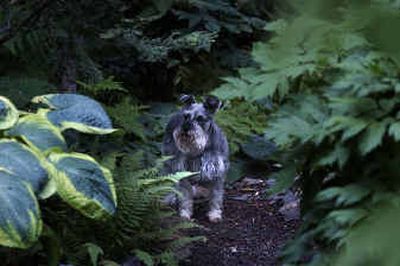
It’s a problem that’s long dogged garden-loving pet owners. How do you manage to maintain prized plants and a beloved pooch without either harming the other?
It’s a balance Theresa Ink has yet to achieve. She is a pet lover, but she’s also passionate about her gardens.
Last year, she spent a considerable amount of time and money landscaping much of her expansive property.
Then came Lee, a powerhouse that’s half yellow Labrador and half Weimaraner.
To maintain domestic harmony, Ink spent several hundred dollars putting in a fence to keep him out of her swimming pool and well-tended gardens. His fenced area takes up about a fourth of the back yard.
Never mind that he’s colorblind. To Lee, the grass is always greener on the other side.
No matter what type of fencing Ink installs, the dog figures out how to open the gate (she now uses a padlock), or tunnels under the fence.
Once he’s made the break, he enjoys a good romp in the gardens and a leisurely dip in the pool.
“At 95 pounds, he tramples everything and it’s Katie-bar-the-door if you’re in his way,” Ink says.
To complicate matters, Lee now has an accomplice in the form of a stray dog Ink brought home recently. “I keep wondering what they’re destroying in my yard while I’m at work,” she says.
While a growing body of research shows pets are good for our physical and mental health, it would be hard to prove by those who come home to find their lawns and gardens in tatters.
Judie Piccola, a longtime animal advocate and rescuer of Doberman pinschers, has had lots of experience with dogs that dig and consider plants a food group. “It’s when they get bored that they start digging and eating plants,” she says.
She’s found some simple ways to handle the digging issue. “The best solution is to give them a place where they can dig,” Piccola says. “Then when they start digging in a hole you don’t want, pour vinegar or ammonia in it and cover it up. The smell will keep them from doing it again.”
She’s also used some of the dogs’ solid deposits, placing them in the hole and covering them, a method that handles digging and disposal matters at once.
But don’t expect dogs that like to dig to stop altogether. Give them an inconspicuous place to vent their energy, such as behind bushes or near a wall.
Piccola also urges pet owners not to leave their dogs outside unsupervised for long periods. “It’s dangerous,” she says. “People steal them; they can jump fences and get out.”
Veterinarian William Kroll shares his home with a greyhound and two high-energy border collies.
Greyhounds are notorious diggers. His solution was to purchase metal fencing known as hardware cloth, lay it over the area the dogs were digging in and mulching it or allowing grass to grow over it.
“It doesn’t inhibit the growth of the grass or plants but will inhibit digging,” he says. “I was able to mow over the top of it. It worked beautifully.”
To keep his dogs out of plantings, he might put in a small lattice fence or a hedge.
For invading cats, he suggests placing a border of mothballs around the area you want them to avoid. The unpleasant aroma serves as an effective deterrent. The barrier will need to be replaced periodically because heat and rain dissolve them.
Another option is to install an invisible electronic fence around gardens. This method, which employs a collar that gives a dog a mild shock when it approaches the fence.
To keep cats and wild critters out of the garden, gardener Kaye Cude lays a flat border of chicken wire around it.
“They don’t like walking on it,” she says.