
Italy
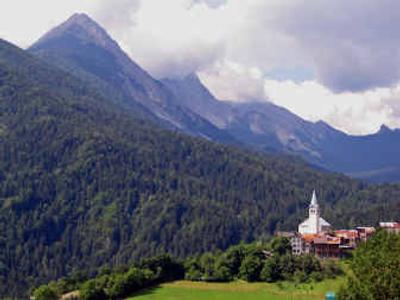
The map said northern Italy, but the landscape said Wyoming.
In fact, the mountains looming over the body of water off to my right looked just like the Grand Tetons guarding Jenny Lake.
Which was funny because just an hour or so earlier, I could have sworn that we’d been driving through Utah’s Zion National Park.
Fact is, though, my wife, Mary Pat, and I definitely were in Italy, making the kind of road trip that we had spent years talking about but had never found the right time.
The unbearable heat of the summer of 2003, though, finally had presented us the perfect opportunity to travel north and trek across what the Italians call La Strada di Dolomiti (known in English as the Great Dolomite Road).
And now we were in, what, Wyoming?
“
Most people think of Italy as Rome and the Colosseum, Venice and its canals, Florence and its museums, the Italian Riviera and its beaches, pasta and pizza, Michelangelo and Leonardo, Ferrari and Beretta.
But Italy is a lot more than what you see in movies such as “Under the Tuscan Sun” (you really should read the book instead). Italy’s 20 regions range from the French-influenced Valle D’Aosta in the northwest to the Asian-African-influenced Sicily in the south, and the range of dialects and customs makes it hard to understand how this boot-shaped peninsula of a country ever managed to bond together under one national flag.
Across the top of the country, the Dolomites spread east to west (and vice versa) like a chain of limestone deposits sculpted by giant artisans. There are places here, in the heart of Italian Tyrol country, where you’re just as likely to see lederhosen and hear German as to see Gucci bags and hear Tuscan Italian.
But that’s not surprising when you consider how the borders have traditionally shifted following one war after the next. The Alto-Adige region itself was ceded to Italy after World War I and still feels Austrian, just as the city of Trieste became Italian for good only in 1954 and still boasts a large Slovene population.
And like most rugged areas of the world, the Dolomites have attracted attention only relatively recently — that is, if you consider a century recent history. Gradually, as roads have cut their way through the mountain peaks and valleys, visitors have followed. Today, snow sports during the winter and hiking during the summer bring thousands of tourists from all corners of the world to such towns as Trento, Bolzano and Cortina.
Neither my wife nor I ski, and we hike only when the buses aren’t running. But we love to drive, and the Great Dolomite Road is said to be one of Europe’s great drives.
We were about to see.
“
We’d begun our trip, as many visitors to Italy do, in Florence. We rented our Fiat hatchback there, driving first to Milan to pick up my wife’s sister Jean and her husband Steve (we call them The Kids). Then we drove due west to the resort town of Aosta, which is a couple of ski runs from both the Swiss and French borders.
We boarded at the hotel Milleluci, a large and comfortable establishment, which has a giant pool, boasts a great view and offers a breakfast buffet sporting enough eggs and cheese and sausages to clog the arteries of the U.S. Olympic ski team.
Our time there was limited, so of the many things to do in the area around Aosta we chose to ride the cable car up the slopes from the ski-lodge town of Courmayeur-Entreves. The ride is multi-staged and, on a day of good weather, will take you all the way into France (edging past the shoulder of Mount Blanc). It was just our luck that on the only day we could take the trip, wind had closed down the longest parts of the ride and fog limited our view.
In the afternoon, the weather cleared up (of course), and under skies bluer than Paul Newman’s eyes we walked around Aosta, past the souvenir shops and restaurants and gelaterias that front smooth rock streets resembling castle courtyards
Then we headed for the Dolomites.
“
After dropping The Kids off in Milan, my wife and I forged our way north, past Trento and on to our stepping-off spot, the town of Bolzano (Bozen in German).
First impressions are different for everyone. But here was mine of Bolzano: I never saw more garages in my life. There were so many that lighted signs actually advertised how many spots were left. The reason why became quickly obvious: People drop off their cars, and pay exorbitant fees, to ski or trek or hike.
We just parked (for free) to stay the night in our ultra-modern hotel.
Owned by the same family for 500 years, the Hotel Greif has been transformed into a chrome-and-glass example of modern comfort (think Starwood’s W hotels), which was a pleasant change from traditional European lodgings with their hard beds, cramped elevators and what many hotel-owners pass off as “old-ward charm.”
Bolzano is something straight out of Heidi’s hope chest. It’s a city of cobble-stoned piazzas and churches with spires that point toward heaven with a kind of hopeful tenacity seldom found outside Salt Lake City. The food is largely Germanic, with lots of pork dishes and strudels, and Americans speaking Italian poorly are likely to be mistaken for, hard as it may seem, Australians. (Or Austrians, Germans or English. When asked where we were from, we got used to replying, simply, “Canada.”)
And among the city’s back streets and churches and castles and museums, there is one sight that no one should miss: the iceman. Otzi, as the 5,300-year-old mummy is called, is kept in a glass-enclosed refrigerated crypt in the Museo Archeologico dell’Alto Adige, and he’s visible only through a small window. Around him is the story of what his life may have been like, and even a life-size Otzi dummy dressed in straw and leathers.
We liked Bolzano so much (and especially the Hotel Greif) that we stayed two nights. And then we hit the road.
“
Here are a few facts that the Frommer’s guide to Northern Italy will tell you about the Great Dolomite Road:
Going west to east (our route) it begins in Bolzano and ends in Cortina d’Ampezzo.
It’s 110 kilometers (or 68 miles) long.
It represents a vertical climb of 2,000 meters.
It takes two and a half hours to drive it one way.
And I quote: “The road curves around some of the highest peaks in the Dolomites, including 3,000-meter (10,000-feet) tall Marmolda, and goes through a scattering of mountain villages and ski resorts before dropping out of a high pass into Cortina.”
Here’s what it doesn’t tell you:
There are nearly as many switchbacks on this road as there are on Maui’s Road to Hana. We counted 33 on the west side of the summit, 29 to the east.
You’re as likely to get stuck behind a tour bus as be forced to give way to a army of mountain bikers, trudging up with grim fervor (“Yah, ve are haffing fonn!”).
But truth is, motorcyclists seem to have the most fun, as long as the weather stays good (the guidebooks warn not to attempt the drive between November and April because of snow). Their view isn’t encumbered as those of us driving cars (for some reason, convertibles are rare in Italy).
Most important to anyone accustomed to Spokane potholes, the road itself is a dream to drive. Despite Montana-like winter weather, which typically does great damage to road surfaces, the pavement I drove on felt smoother than a pool table.
When I get on the road, especially in Europe, I tend to concentrate on my driving. That’s why we always try to pull off once in a while so that I can enjoy the scenery, and take a few photos.
And the scenery on the Great Dolomite Road is worth stopping every couple of miles to study. From the Zion Park outcroppings of dark rock to the Teton-like stark peaks to the treeless rock formations that lead up the road’s summit, 7,346-feet Porsoi Pass, the drive doesn’t offer just one type of landscape beauty.
As I wrote in my journal, “If you read any guide book, you’re likely to come across phrases such as ‘wonderful’ and ‘great’ and even the occasional ‘awesome’ to describe the vistas offered in nearly every direction.”
Being the good place-droppers that we are, we compared everything we saw to, among others, the Sierra Nevadas, the Cascades, the high prairies of western Montana and Wyoming’s Jackson Hole region. (In contrast, when we head back to sea level, I looked at the surrounding crop fields and said, with a knowing nod, “I-5, northbound to Portland.”)
“
Cortina, which is the eastern-most point of the official drive, has a reputation of being “the jewel of the Dolomite Road.” And it is one of those spots in Italy that the Italians themselves flock to during winter, what with its (according to one online source) 110 kilometers of ski slopes, 58 more cross-country routes, all of which are served by 37 lifts (five cable cars, 23 chair lifts and 9 ski lifts.)
Cortina underwent an extreme makeover following World War II, which may be why the 1956 Winter Olympics were held there.
But if you drive into it the way we did, late in the afternoon, tired and simply wanting to find your hotel, get something cool to drink and sit in the sun, Cortina is less than charming. It feels like a typical resort town, with lodge after lodge lining both sides of the road. And coming into the center of town, the traffic patterns can be — as with much of Italy — confusing.
In any event, we ended up merely driving through, dodging the pedestrians (probably tourists much like we were), en route to our lodgings.
Once at the Hotel Menardi, we discovered a chalet-like place, with wooden floors and walls and bed frames and shutters… so much wood, in fact, that it made us wonder whether there were any trees left in the neighborhood.
But a simple look out the back, past the immense grassy knoll to a Centennial Trail-type hiking path, and we could see more species of evergreens than even Smokey the Bear could identify.
“
Anyway, the trip for most people ends there. But not for us. Because when we left Cortina, we drove on into the historic city of Trieste.
Trieste, which bridges Slovenia to the east and the Adriatic Sea to the south, doesn’t strike many as a natural tourist stop. As British travel writer Jan Morris wrote in her book “Trieste and the Meaning of Nowhere,” the city “offers no unforgettable landmark, no universally familiar melody, no unmistakable cuisine, hardly a single native name that anyone knows.”
Yet, Morris’ book, as most good travel journals tend to be (read any of Paul Theroux’s nonfiction), is more about her relationship with Trieste than Trieste itself. For me, Trieste was a city I had longed to see. And what I found was a city best described in words that accompanied an art exhibit we visited that was devoted to the life of the German philosopher Friedrich Nitezsche.
As one of his female acquaintances said, “Vicino a Nietzsche avevo l’impressione di un enigma e di un mistero.” That same phrase could easily describe Trieste: Next to it is a feeling of enigma, of mystery — as far from the Disneyland-like nature of, say, the Italian Riviera as you could find.
That feeling was underscored our final night at the hotel Riviera and Maximilian’s, an atmospheric establishment perched on a cliff some 100 feet above the Adriatic. We sat on the deck, sipping ice cold white wine while chatting with our waiter (who politely dumbed his Italian down enough to match ours).
And as the sun set slowly, we sighed and watched as the lights blinked on one by one down the distant southern coastlines of Slovenia and Croatia,
I didn’t see Trieste first as a young soldier, as Jan Morris did. I skipped right to the second part, when mystery and enigma claim far less of a hold on the imagination than they do on memory.
But that’s the good news. Because coming to the city later in life allowed me to react to it like Rick Blaine (Humphrey Bogart’s character in “Casablanca”), who gallantly says goodbye to the great love of his life with the words, “We’ll always have Paris.”
And we always will have Trieste.
That and the Great Dolomite Road that led us to it.