
Competition lends itself to inspiration
Five tongue depressors, four paper clips, three rubber bands, an index card, a roll of masking tape and one straw.
With those materials, plus a pool of ingenuity, teams of students from around the state spent 45 minutes Wednesday morning devising and building a mini-marshmallow catapult.
Some students launched right in, fiddling with different configurations of clips, sticks and rubber bands. Others sat back and watched their teammates, planning things out mentally before beginning construction. Still others provided a running commentary: “Here, try this with a rubber band. Oh man, that really messed it up now.”
Two high school and two middle school teams from Seattle, one each from Tacoma and one each from Spokane filled the East Central Community Center with clever ideas Wednesday for the Mathematics, Engineering, Science Achievement (MESA) State Competition. Winners go on to the MESA USA competition June 24-27 in Albuquerque, N.M.
MESA started in 1982 at four high schools; now more than 5,000 students from 23 school districts in Washington participate. In Spokane, about 400 students participate in MESA. The idea is to target minority and female students, to help develop their interest in math and science.
“There is a crisis in the United States for us to produce our own technology work force,” said MESA state director Patricia MacGowan. Of the state’s engineering degrees, fewer than 30 percent go to women and fewer than 10 percent go to minority groups, she said. “We have to help students see what’s in those industries — that they are good jobs, with good wages.”
MacGowan said that 30 percent of MESA kids go on to get college degrees in math and science.
Though many of the MESA activities look like play, there’s serious figuring going on.
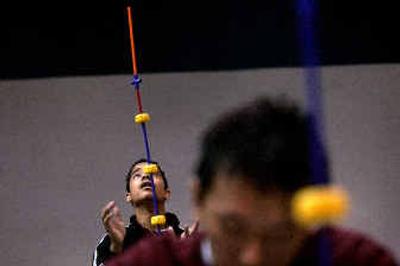
For the tower challenge, students had to build the tallest Tinker Toy tower they could for the lowest cost; each rod or fastener was assigned a price. Most groups just started by putting pieces together, but the West Seattle High School team first organized all their pieces by size and price.
West Seattle 10th-grader Shirley So, who’s been in MESA since seventh grade, said she loves how much she learns while doing the projects, and having the opportunity to actually apply what she’s learned.
The key to a good MESA team, she said, is having people who are willing to let others demonstrate their ideas.
Teammate Tracy Le agreed, and added: “It’s having people who appreciate and understand you.”
Besides competing in the on-site tasks, students also had to bring with them a mousetrap-powered multi-purpose vehicle of their own creation. Poster displays detailed their research on friction, traction, inertia, and potential and kinetic energy. A written paper explained the various modifications they made while perfecting their vehicle. The goal was to create something that would travel 10 meters and roll up a 30-degree incline.
Jennifer Richling, an eighth-grader at Spokane’s Salk Middle School, said she and her partner worked on their car for two months, before and after school, and some Saturdays. But on Wednesday, the car didn’t make it up the ramp and only rolled 9.5 meters.
“We’re hoping the poster and paper will make up for it,” she said. Though she loves science, “math isn’t my big thing,” Richling said. The MESA projects – such as figuring the dimensions of the car and what’s needed to improve its performance – have really helped her math skills, she said.
And that’s what keeps students hooked.
“You get to challenge yourself,” explained Dudley Monfort, a senior at Lake Spanaway High School. “You figure out what to do using communication. You get to learn something by just using your brain.”