
Heisman hopeful?
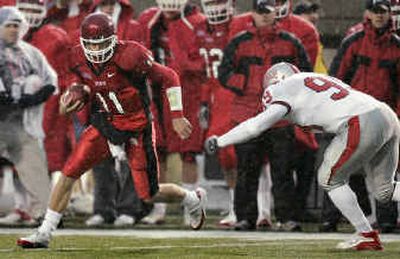
Quarterback Alex Smith chortled instinctively the moment the question fell from a reporter’s mouth:
Can you win the Heisman Trophy?
“That’s not something I’m realistically looking at, no,” he said.
Yet the No. 7 Utah Utes are doing what they can to promote his candidacy, and it’s not inconceivable that the standout junior at least will be invited to New York City next month as one of the handful of finalists for the annual award honoring the nation’s most outstanding college football player.
“He’s the best quarterback I’ve ever been around,” coach Urban Meyer said.
With Smith piling up victories and statistics that compare favorably with those of some of the favorites for the award – he has more passing yards than Southern Cal’s Matt Leinart, for example, and a better passing efficiency than Oklahoma’s Jason White – the Utes and their coach have made a conscious effort at calling attention to them.
Meyer dedicated a portion of his weekly press conference to promoting Smith for the award, and the national news media have increasingly referred to him among the serious candidates for the award.
“Maybe other people have other opinions,” Meyer said, “but I’ve been around some tremendous players, and he is the best. … I think he’s the best quarterback in college football right now.”
Perhaps that’s true.
Smith is, after all, ranked third nationally in passing efficiency. He averages 286.1 passing yards per game, completes 64.5 percent of his passes, and has thrown 20 touchdowns against just two interceptions. He also has rushed for 384 yards and six touchdowns for an unbeaten team that’s ranked higher than ever before and threatening to bust into the Bowl Championship Series.
But is that enough?
Not since Brigham Young’s Ty Detmer in 1990 has a player from a school outside the six conferences aligned with the powerful BCS won the award, and even that required head-spinning statistics and a massive promotional campaign of little paper neckties boasting of them.
The Utes say they’re not ready to do anything like that, or pay $250,000 to erect a billboard in Times Square, the way the University of Oregon did three years ago to promote quarterback Joey Harrington for the Heisman.
“I don’t think that helps,” Meyer said. “I think that’s all phony, and I hope college football hasn’t come to that.”
Maybe not.
Some members of the news media who vote for the Heisman maintain none of those promotional gimmicks matter – especially not in the case of Smith.
“Can he win the award?” said Stewart Mandel of Sports Illustrated.com. “Unfortunately, probably not. The Heisman electorate is filled with people who only casually cover the sport … who have not yet caught on or perhaps refuse to accept the fact that Utah is a legitimate team.”
What’s more, Smith plays the same position as many other high-profile candidates for the award, from Leinart to White to Cal’s Aaron Rodgers, and suffers from a lack of national exposure in the Mountain West Conference.
The Utes have played on national television only twice this season, once in the last month, and have a hard time convincing people they don’t generally play against lesser competition.
“Heisman voters like to say: What would Utah’s record be if it played in the SEC and had to play at Auburn, at Georgia, at LSU?” said Chris Dufresne of the Los Angeles Times. “Alex Smith has to fight these preconceptions in a year when there are tons of great QBs out there. It’s not fair, perhaps, but since when has college football been fair?”
Detmer obviously endured those same challenges and proved that a player from a school other than USC, Michigan or Notre Dame can win the 69-year-old award.
But “the difference is Detmer was putting up astronomical numbers,” said Keith Whitmire of the Dallas Morning News. “Alex Smith isn’t quite in that category, therefore his candidacy is based in part on intangibles. That makes it difficult for a player from a non-traditional football power to make an impression on voters. Andre Ware and Barry Sanders won Heismans playing for non-traditional powers, but they, too, had amazing statistical seasons.”
Indeed, Detmer set an NCAA record with 5,188 passing yards in 1990, and threw for 41 touchdowns in 12 regular-season games – numbers Smith won’t touch.
Every race needs a dark horse contender, though, and it’s not impossible to imagine Smith becoming this year’s Chad Pennington, if the Utes finish undefeated.
The Marshall quarterback faced many of the same obstacles that Smith does, yet finished fifth in the balloting in 1999. That earned him a trip to New York City for the final announcement, just like fellow Thundering Herd stars Randy Moss in 1997 and Byron Leftwich in 2002.
“I predict if they go undefeated, and assuming he stays healthy, he will be invited to New York, but won’t win,” Mandel said.
Receiving even one vote for the Heisman would be something that no other Utah player has done in years, and getting an invitation to the final announcement on Dec. 11 would only add to the national legitimacy the Utes are building under Meyer.
It also would set the stage for an even stronger candidacy next year.
“Next year?” Dufresne said. “Now you’re talking. A school like Utah needs a running start at a Heisman campaign and the momentum has to start building in July and August, not October and November.”