
Small Details
It used to be the American dream: Get a good job, fatten up the savings account and buy the biggest house you can afford. But more and more young professional couples have a different idea and are opting out of the big house race. They are choosing to keep it small.
In her 1998 groundbreaking book, “The Not-So-Big House,” author Sarah Susanka re-introduced the concept of settling for “big enough” rather than contributing to the popular movement toward urban sprawl and what she calls “starter castles.”
In 2000 Susanka followed up with “Creating the Not-So-Big House.”
“People are eager for an alternative to the bigger-is-better approach to home design,” Susanka wrote.
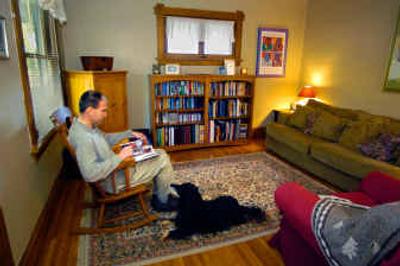
Spokane’s David Crowner and Carolyn Morrill agree. Crowner is the operations director of the Spokane International Airport and Morrill is a veterinarian. The couple shares their tiny South Hill cottage – Crowner calls it an urban cabin – with three cats and a dog.
The small 1909 house looks like something out of a fairy tale. Sitting on a lot carved out of nearby lots, the house has big charm. A covered patio connects the house with the detached garage. A large oak tree shades the postage stamp-sized front yard.
Crowner and Morrill weren’t in the market for a new home when they stopped by an open house in 1997. “We were on our way to a concert and saw the sign,” Morrill says. “We called the realtor the next day.”
The house has less than 850 square feet on the main floor with the addition of a bedroom a previous owner squeezed into the basement.
Crowner and Morrill were renting an apartment that was larger than the little house. But they were charmed by its small size. “When I was a child my bedroom had everything I needed; as a student I lived in a little studio,” Morrill says. “I think small spaces are more comfortable.”
They also liked the idea of not having the amount of upkeep required for a larger house. And Morrill finds living in a small house provides a way to simplify. “There are times when I think it would be nice to have a bread maker or a rice cooker,” she says. “But I don’t have the space for it, so it keeps you in check.”
“The bigger the house you have the more you need to fill it,” Crowner adds. “Pretty soon you’re stuck.”
Others share that view. According to Spokane real estate broker, Nancy Wynia, interest in small, well-built homes is growing. “There is a strong market for homes that have 1,300 to 1,700 square feet,” Wynia says. “But people, especially young buyers, don’t want to sacrifice the amenities just because they are buying small.”
For Crowner and Morrill, vintage details like hardwood floors, impressive woodwork and a convenient neighborhood more than made up for the lack of square footage. “I think the whole thing is that we looked for character over space,” Crowner said.
Brad Spears, president of the Spokane Home Builders Association, says that builders are beginning to see a trend toward smaller, or at least, more efficient homes.
“I’ve noticed a trend toward one level living, with the parents on the main floor and the kids bedrooms in a daylight basement,” Spears say. “They don’t necessarily want the two story house everyone was building a few years ago.”
And he agrees with Wynia that building small doesn’t have to mean scrimping on the amenities.
He points to the ultra upscale “Black Rock” development in Coeur d’Alene – a private community of small, less than 3,000 square feet homes, being marketed to celebrities and other wealthy multi-home buyers – as an example.
“They are calling those homes ‘cabins,’ ” Spears says. “And they sell for close to a million dollars.”
Wynia wishes there were more small-house communities being built in the Spokane area.
“I have people who would love to find a not-so-big house, maybe built around an art center, or something like that,” she says. “I think a lot of people would find that appealing.”
Crowner and Morrill admit that even by small-house standards their cottage is tiny. And now that they are expecting their first child, a move is in the future. But they’re still not thinking big.
“I don’t want a mansion, with ceilings that go up to the sky so you lose the feeling of warmth,” Morrill says.
They will stay true to the “less is more” philosophy. “Ideally, you just buy what you need,” Crowner says. “Then, when your needs grow, you grow with them.”