
By casting first vote, she takes first step to reshape her future
Election Day dawned last week with Sonja Vernier feeling proud. For the first time in her 31 years, she actually voted.
When her absentee ballot arrived in the mail, she marked it with a pen stroke of power, and mailed it back to ensure her voice would be counted.
This was the election year that Sonja Vernier gained a new level of awareness. During past campaign seasons, caught up in one bad, bleary-eyed choice or another, she blinked groggily when elections came around. One November she could have sworn it was the wrong year for another election. But there it was.
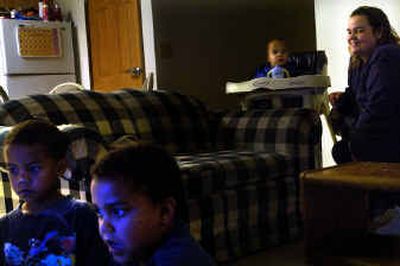
This year Sonja took control. She moved her three little boys, Bakari, Joaquim and Malik, into the Salvation Army’s new transitional apartments for the homeless on East Nora Street. On Election Day, in a brand new kitchen smelling of fresh paint and spaghetti sauce, she scooped up penne pasta for her boys and described her decision to vote.
“Man, I was happy,” she said. “I was like, ‘I voted.’ You can tell the people who care about what’s going on in the world and the people who don’t.”
That evening a Mario Brothers game beeped and bonged on the television set as Joaquim and Bakari battled in the living room. Nearby, seven leafy plant starts, fragile and strong as 18-month-old Malik himself, sprouted in the window.
“If I can’t get my family straight, we’ll need to be supported for the rest of our lives,” she said. “If I can’t be self-sufficient, I’ll always need help from somebody.”
This fall, as Sonja took charge of her new life, voting loomed as one more small but influential act of control.
She seized the opportunity, and in this presidential election, like nearly 120 million other Americans, she cast her ballot. She selected the man who appeared “the lesser of two evils,” the wealthy Yale graduate she deemed more likely to keep the needs of her three little boys in mind. She voted against the president. “I think he was more pro-wealthy than pro-lower class and low-income like myself,” she said. “I just want programs that are out there for low-income people to stay there.”
It’s not like Sonja Vernier’s always been dependent on government help. For 12 years, she says, she worked as a waitress in Olympia, one of the working poor who paid taxes and earned her own living. She lost that job in the chaos of a meth addiction, but now, after nearly a year in treatment and another year since, she’s bringing order to her life. She hopes to one day translate a talent with numbers into an accounting degree, and she dreams of a house with a white picket fence and acreage for her young boys to run free.
Sonja and her boys live on a monthly check of $577 and $346 in food stamps. State medical insurance pays for Malik’s prescription for Prilosec, a medication he needs to treat acid reflux disease. Without help, Sonja would pay $192 a month for that drug alone.
“When it comes to my family, I’m planning to move up to get the wealthy tax credit,” Sonja said. “It’s possible, but with three kids and no fathers around, it’s hard.”
The version of the American dream Sonja envisions will require her full consciousness and daily discipline. She needs to complete two years at a community college and two more at a university after that.
On Election Night Sonja’s small son Malik leaned over her kitchen table, a walnut-sized purple bruise looming above his chocolate-drop eyes, his slender fingers plucking pieces of pasta from his plate.
He’s one of the three best reasons in Sonja’s life for grasping that pen and making her own choices for the country’s future.
The next day, television anchormen announced Sonja’s candidate lost the election. But she was philosophical. “Bush won, didn’t he?” she asked. “The majority has faith in him. I guess it will be OK. I’m just happy I tried to do my part.”
This week, as we absorbed the results of the election, voters’ reactions ranged from elation to despair. Among the nearly 120 million stories that each of our votes represent, there came on East Nora Street a moment of celebration.
It occurred in the life of Sonja Vernier, who cast her ballot for a man who ultimately lost, but gave her hope.
We’d all do well to celebrate our individual decisions to vote this week. Before we get carried away in the emotions surrounding the results, let’s pause to appreciate the level of consciousness required to take a risk, wade through a confusing list of candidates and initiatives, and make our own choice.
Voting remains for each of us a small triumph over the all-too-human impulse to escape reality. It’s a call to awareness; it’s a chance to express our opinion; it’s a moment to exert influence over the years to come.
Sonja Vernier voted the very first time this election, and she wound up, not disillusioned over her candidate’s loss, but gleeful over the power she wielded.
“I feel like I’m going down the right path,” she said on the telephone Wednesday afternoon. “I’m doing something I care about. I’m helping shape my future.”
Besides, she said with a laugh, the boys hollering in the background, “I’m sure somebody I voted for got elected.”