
Fallujah attack rolls on
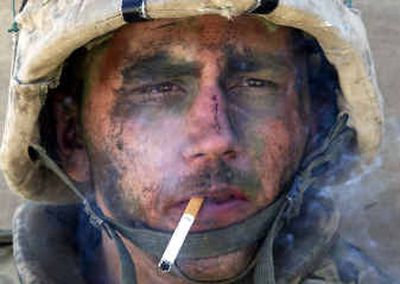
NEAR FALLUJAH, Iraq – American forces battled south through Fallujah’s narrow lanes and alleys today to take control of 70 percent of the insurgent stronghold, and rebel fighters were bottled up in a strip of land flanking the main east-west highway that splits the city, the military said.
Major Francis Piccoli, of the 1st Marine Expeditionary Force, characterized fighting overnight as “light to moderate” and said U.S. casualties were “extremely light.”
“There’s going to be a movement today in those areas. The heart of the city is what’s in focus now,” he said.
The northwestern neighborhood of Jolan, the historic warren of crooked streets where Sunni militants and foreign fighters had rigged booby traps, was now “secured and under control,” he said, although Marines were expected to continue house-to-house searches for fighters and weapons.
The military said at least 71 militants had been killed as of the beginning of the third day of the intense urban combat. The number was expected to rise sharply once U.S. forces account for insurgents killed in airstrikes.
As of Tuesday night, 10 U.S. troops and two members of the Iraqi security force had been killed, a toll that already equaled the number of American troops who died when Marines besieged the city for three weeks in April.
Marine reports today said 25 American troops and 16 Iraqi soldiers were wounded.
Also today, one U.S. soldier was killed and a second was wounded by a roadside bomb north of Baghdad. In northern Iraq, six Iraqi soldiers died and two were wounded when a roadside bomb detonated near an Iraqi military camp.
Earlier, as many as eight attack aircraft – including jets and helicopter gunships – blasted guerrilla strongholds and raked the streets with rocket, cannon and machine-gun fire ahead of U.S. and Iraqi infantry as they advanced just a block or two behind the curtain of fire.
Small groups of guerrillas, armed with rifles, rocket-propelled grenades, mortars and machine guns, had engaged U.S. troops, then fell back. U.S. troops inspected houses along Fallujah’s streets and ran across adjoining alleyways, mindful of snipers.
A psychological operations unit broadcast announcements in Arabic meant to draw out gunmen. An Iraqi translator from the group said through a loudspeaker: “Brave terrorists, I am waiting here for the brave terrorists. Come and kill us. Plant small bombs on roadsides. Attention, attention, terrorists of Fallujah.”
Despite resistance being lighter than expected, the top U.S. commander in Iraq said Tuesday he still expected “several more days of tough urban fighting” as insurgents fell back toward the southern end of the city, perhaps for a last stand.
“I’m surprised how quickly (resistance) broke and how quickly they ran away, a force of foreign fighters who were supposed to fight to the death,” Lt. Col. Pete Newell, a battalion commander in the 1st Infantry Division, told CNN.
The move against Fallujah prompted influential Sunni Muslim clerics to call for a boycott of national elections set for January. A widespread boycott among Sunnis could wreck the legitimacy of the elections, seen as vital in Iraq’s move to democracy. U.S. commanders have said the Fallujah invasion is the centerpiece of an attempt to secure insurgent-held areas so voting can be held.
Prime Minister Ayad Allawi declared a nighttime curfew in Baghdad and its surroundings – the first in the capital for a year – to prevent insurgents from opening up a “second front” to try to draw American forces away from Fallujah. Clashes erupted in the northern city of Mosul and near the Sunni bastion of Ramadi, explosions were reported in at least two cities and masked militants brandished weapons and warned merchants to close their shops.
In Fallujah, U.S. troops were advanced more rapidly than in April, when insurgents fought a force of fewer than 2,000 Marines to a standstill in a three-week siege. It ended with the Americans handing over the city to a local force, which lost control to Islamic militants.
This time, the U.S. military has sent up to 15,000 U.S. and Iraqi troops into the battle, backed by tanks, artillery and attack aircraft.
“The enemy is fighting hard but not to the death,” Lt. Gen. Thomas Metz, the multinational ground force commander in Iraq, told a Pentagon news conference relayed by video from Iraq. “There is not a sense that he is staying in particular places. He is continuing to fall back or he dies in those positions.”
Metz said Iraqi soldiers searched several mosques Tuesday and found “lots of munitions and weapons.”
Although capturing or killing the senior insurgent leadership is a goal of the operation, Metz said he believed the most wanted man in Iraq, Abu Musab al-Zarqawi, had escaped Fallujah.
It was unclear how many insurgents stayed in the city for the fight, given months of warnings by U.S. officials and Iraqis that a confrontation was in the offing.
Metz said troops have captured a very small number of insurgent fighters and “imposed significant casualties against the enemy.”
Before the major ground assault that began Monday night, the U.S. military reported 42 insurgents killed. Fallujah doctors reported 12 people dead. Since then, there has been no specific information on Iraqi death tolls.
The latest American deaths included two killed by mortars near Mosul and 11 others who died Monday, most of them as guerrillas launched a wave of attacks in Baghdad and southwest of Fallujah. It was unclear how many of those died in the Fallujah offensive, but the 11 deaths were among the highest for a single day since last spring.
But the toll in Fallujah could have been higher. Early Tuesday, a helicopter gunship destroyed a multiple rocket launcher aimed at the main American camp outside of the city.
“That saved our lives,” Col. Michael Formica, commander of the 1st Cavalry Division’s 2nd Brigade, told the crew. “We have no idea how many soldiers here were saved by your good work.”
Formica said the security cordon around the city will be tightened to ensure insurgents don’t slip out.
“My concern now is only one – not to allow any enemy to escape. As we tighten the noose around him, he will move to escape to fight another day. I do not want these guys to get out of here. I want them killed or captured as they flee,” Formica said.
U.S. officials said few people were attempting to flee the city, either because most civilians had already left or because they were complying with a round-the-clock curfew. A funeral procession, however, was allowed to leave, officials said.
Anger over the assault grew among Iraq’s Sunni minority, and international groups and the Russian government warned that military action could undermine elections in January. The U.N. refugee agency expressed fears over civilians’ safety.
The Sunni clerics’ Association of Muslim Scholars called for a boycott of the elections. The association’s director, Harith al-Dhari, said the Sunnis could not take part in an election held “over the corpses of those killed in Fallujah.”
The call is expected to have little resonance within the rival Shiite Muslim community, which forms about 60 percent of Iraq’s 26 million people.