
Helping caregivers avoid stress
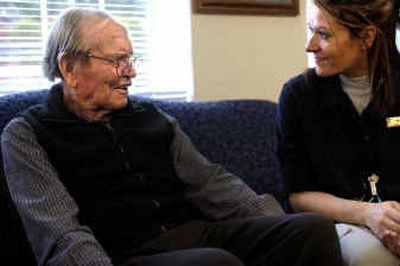
Bill Aitchison never gave caregiver stress a second thought. Like any loving husband, when his wife of 60 years, Racelia, started losing her memory, he simply pitched in and did more.
“You just start moving in and doing the things they aren’t doing. I used to think that she’s getting more forgetful, so I need to remember more.”
The Spokane resident was one of a dozen people attending a Saturday seminar, held at Park Place Retirement Community, to help people caring for loved ones with Alzheimer’s disease and dementia have a less stressful holiday season.
Because caretakers are notorious for ignoring their own well-being, they can get overwhelmed during the holidays, explains Darrelle Volwiler, a counselor and volunteer for the Alzheimer’s Association.
It’s usually one family member who assumes the task of caring for a person at home or overseeing their care at a facility. As the holidays near, these superheroes juggle round-the-clock responsibilities with trying to single-handedly carry on dozens of traditions. Many are also raising children. Between parenting, decorating, cookie baking and gift buying, they risk burnout.
Volwiler encourages caretakers to protect their own physical and mental health by taking vitamins, visiting doctors, exercising and connecting with friends.
“Some really literally have no life. I’ve heard caretakers report they haven’t been out with a friend for one year, and that’s ridiculous,” she said.
Lowering expectations, prioritizing and reaching out to siblings for help, she explains, are keys to decreasing stress.
Hiring an outside respite worker for a few hours or taking the patient to an adult daycare, like Holy Family Adult Day Center, can provide a much-needed break. A recent study cited by Volwiler found that caregivers who have four pleasant experiences a day – such as listening to music or making crafts – are less depressed.
“The research was very clear. We can’t stop living because of our caregiver responsibilities,” she said.
While Aitchison was tending to Racelia, who is now at Cheney Care Center, he took a water aerobics class at the YWCA. Because he was uncomfortable about leaving his spouse during the day, he went before she awakened. His classmates, also seniors, proved to be godsends.
“This became my support group, unwittingly,” Aitchison said. “I didn’t realize I was having a problem, but they knew it and they were around for me the whole time.”
In dealing with the holidays, Russ Kelley, a psychiatric nurse who teaches college classes and directs Park Place’s assisted living unit, suggests that caregivers pick the traditions they want to observe, simplify others and give themselves permission to forego the rest.
“No one can expect you to maintain every holiday tradition or event. Focus on what you enjoy,” Kelley said.
Deborah Harder of Spokane Valley and her family came to Saturday’s seminar, seeking ideas to help her father-in-law enjoy the holidays. After losing his wife a year ago, his memory loss worsened and he was placed in a care facility.
“It’s hard because you know how vital and active he has been,” Harden said. “Our family life fabric, it kind of feels like it’s all unraveling.”
She has watched her three children, ages 16 and older, struggle with losing one grandparent and watching the other go downhill. The big family gatherings the children loved are now rare as the family faces the mammoth task of helping a memory-impaired parent.
Kelley said families should allow themselves to grieve or feel angry. He said while it’s important to engage loved ones in the holidays, that person has changed and may not be capable of much celebration.
Harder’s father-in-law, who loved woodworking and gift-giving, could be given a pre-cut wood project that he can sand and finish, Kelley suggested. A mom who enjoyed baking might help bake cookies and then package them as gifts. Former shoppers might go to a store where family members lead them toward cards and gifts that have been pre-selected. Catalogs can fill the void for givers who lack stamina.
Often, people in the mid- to late stages of Alzheimer’s will ask when a deceased loved one is going to visit. When that happens, Volwiler suggests playing along because reintroducing news of a death can devastate the individual.
“It’s better to just say Uncle Harry is going to come and visit us sometime soon and then distract them.”
Because holiday bustle can be overwhelming for latter-stage Alzheimer’s patients, Kelley suggests minimizing clutter and confining most decorations to one room.
Many precautions that are recommended for toddlers, including avoiding candles and breakable ornaments, also make things safer for Alzheimer’s patients, Kelley said.
As Aitchison’s four children and their families make holiday visits, Bill will keep visits with their mother on the quiet side, so she doesn’t get overwhelmed. Together, he and his children have reached a level of acceptance.
“I’m so fortunate in having a very supportive family. None of us are happy about this, but none of us are unhappy about this either.”