
Flawed report on terrorism gets even worse

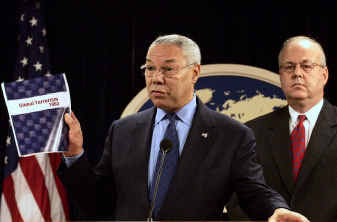
WASHINGTON – Five months after embarrassed State Department officials admitted to widespread mistakes in the government’s influential annual report on global terrorism, internal investigators have found new and unrelated errors – as well as broader underlying problems that they say essentially have destroyed the credibility of the statistics it is based on.
In a 28-page report, the State Department’s Office of Inspector General blamed the problems on sloppy data collection, inexperienced employees, personnel shortages and lax oversight. Investigators also concluded that the procedures used by the State Department, CIA and other agencies to define terrorism and terrorist attacks are so inconsistent that they can’t be relied upon.
The department’s independent investigative unit concluded, however, that politics played no role in allowing so many mistakes to be published in the original version of the “Patterns of Global Terrorism” report for 2003.
The 2003 report said that terrorist attacks and related deaths had dropped to the lowest levels in three decades, and top Bush administration officials immediately touted it as proof of their success in the global war on terrorism.
But the underlying data actually showed a sharp increase to a 21-year high. The 199-page report, made public on April 29, also omitted any significant terrorist attacks occurring after an early November cut-off date, including bombings in Turkey that killed at least 62 people, and left out some activity in Chechnya, Iraq and other locations.
Those errors were fixed in a second version of the terrorism report, released on June 22. But six Democratic senators, suggesting the Bush administration was manipulating terror statistics for election-year political gain, asked Secretary of State Colin Powell to find out what had gone wrong, prompting the investigation by the inspector general. A copy of the inspector general’s conclusions, marked “sensitive but unclassified,” was obtained by the Los Angeles Times.
The annual report has been mandated by Congress since 1987 as the government’s authoritative reference tool on worldwide terrorist activity, trends and groups and the U.S. response to it.
The document is relied on by Congress and U.S. counterterrorism agencies in deciding how to wage the ongoing war on terror, and is translated into at least four languages so the public, academics and foreign governments can use it to assess trends in terrorism.
The investigators, overseen by the State Department’s acting inspector general, Cameron R. Hume, stopped short of calling for a second revision of the widely circulated report. But they concluded that the report, even in its revised form, “cannot be viewed as reliable” because of the questionable statistics on terrorist attacks, casualties and other issues. The report urged better oversight and management of the annual terrorism report card “in order to produce a world-class product.”
A State Department spokesman declined to comment publicly on the internal report, but said the department has no plans to review or reissue the 2003 “Patterns” document a second time.
“We think it’s best to just move on, and make sure we fix what needs to be fixed,” said the official.
On Friday, Sen. Patrick Leahy, D-Vt., one of the lawmakers who requested the investigation, said the lack of objective benchmarks to measure terrorist activity jeopardizes the campaign against terror. “Either through indifference or incompetence … these errors have damaged the credibility of this important assessment, undermining our ability to determine what policies and programs are effective in fighting terrorism,” Leahy said.
A senior congressional official said the inspector general’s findings confirm what experts have been saying for years – that the annual “Patterns” report is seriously flawed as a tool to measure progress in the war on terrorism, or analyze the rapidly changing nature of terrorism.
“We become the laughingstock if we redo it. But (not doing it) poses a serious credibility problem,” said the official, a terrorism analyst on Capitol Hill. “This determines where we put our resources, what we tell other countries, what we think the trends are. And this just ruins our credibility. People just don’t trust us anymore.”
Michael Kraft, a senior counterterrorism official in the State Department until earlier this year, defended the annual “Patterns” report as immensely valuable, and said it is almost impossible to be entirely accurate given all of the variables that go into analyzing terrorism.
“It’s not always easy. The numbers themselves don’t always mean a great deal. They have to be put in context,” Kraft said. “Even with the best of efforts – and a lot of time and work goes into it – there is always going to be a certain amount of fuzziness.”
But investigators identified more systemic shortcomings, particularly a long-standing failure by the State Department, CIA and other agencies to use consistent standards to identify and classify terrorism-related events.
For example, some multiple bombings in the same city – such as bomb attacks on March 25, 2003, on four U.N. police stations in Pristina, Serbia, and attacks on two embassies in Caracas, Venezuela, on Feb. 25 – were counted as single terror incidents. But grenade attacks on two targets in Kashmir on April 12, and bomb attacks on two synagogues in Istanbul on Nov. 15, were each listed as two terror incidents.
Additionally, some items were included or dropped without apparent reason. The discovery of an explosive device at an IBM facility in Italy on March 31 was deleted without explanation from the second version of the 2003 report. But a parcel bomb hidden in a book that was sent to the Greek consulate in Madrid on Sept. 8 was added to the revised version.
Investigators said no records or minutes are kept to explain how these decisions are made. Thus officials “could only speculate on why some events were included or not included,” according to the report.
Meanwhile, there appear to be obvious inconsistencies within the revised 2003 report, said another congressional staff member. Among them: The corrected report lists 2,738 people as casualties of international terrorist attacks in 2002 in one section, but 3,072 casualties, or 334 more, in a separate statistical review.
Long-standing guidelines have not kept pace with changes in terrorism.
The report considers international terrorism to be violence against noncombatant targets by subnational groups or clandestine agents and which involves citizens of two or more countries.
This effectively omitted countless incidents in Chechnya and Iraq.