
Merchants’ sales are clicking
Spokane dentist Peter Sturm does 80 percent of his holiday shopping online. He likes the convenience, the unique gifts he finds and the comfort of shopping from his own home, with no holiday crowds to battle.
“Our shopping is stress-free and finished early,” Sturm said.
Alberta Payne of Chattaroy doesn’t shop much online because she prefers to go into stores to inspect items first hand.
“I like to touch and feel what I buy,” Payne said. “I’m of the old school.”
With the traditional launch of the holiday shopping season looming, retailers in the Inland Northwest are gearing up to satisfy both types of customers. Merchants are well accustomed to preparing their stores for the biggest shopping season of the year. However, many are saying they feel the need to either have a presence online or beef up their Web sites to meet the demands of consumers who expect to find them in cyberspace.
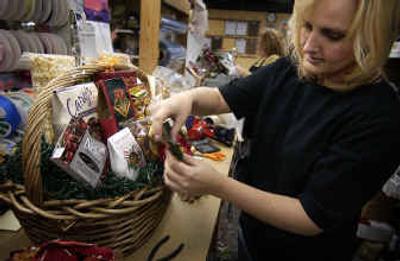
“I believe our Internet business will only grow, and it could be huge,” said De Scott, owner of Simply Northwest, a gift shop in Spokane Valley. “We have a plan that includes the Internet and it will be nationwide.”
The 2004 holiday shopping season is expected to generate 4.5 percent more in sales this year compared to last year, for a total of $219.9 billion, according the National Retail Federation. Though online sales aren’t broken out of that figure, federation spokesman Scott Krugman said they only represent about 5 percent of the total.
However, the federation estimates that total online sales for 2004 will hit $144.6 billion, a 27 percent increase over last year. In 2003, online sales grew by 51 percent from the year before. And with retailers reporting that the Christmas shopping season accounts for 25 to 40 percent of annual sales – higher in some categories – being online is becoming a necessity for many, rather than a luxury.
Scott said she believes her Web site was among the first in the region when she launched it in 1994 with videotaped images of her gift baskets, but no online ordering. That was added in the late 1990s. Now, with her store offering so many more gifts items, Scott said she’s planning a $30,000 upgrade to her Web site following the first of the year to allow customers to buy everything she offers online.
Last year, Scott said, online sales grew to 6 percent of her total sales, which was double the prior year. This year, she anticipates that will double again, to 12 percent. Holiday sales generally produce about half the year’s business, she said. Nationwide, the retail federation projects online sales in gift stores will grow by more than $1 billion this year.
“A lot of people will look at the Web site then they’ll call in and order,” Scott said. “We want to be able to add more things and track things better than we do.”
Scott said she also works hard to counteract the impersonal nature of the Internet, by responding quickly to customer inquiries. She thinks that as online shopping grows even larger, customer service will continue to set apart the companies that succeed.
“People still like to touch, feel. We are human. That’s in our nature,” Scott said. “If I can’t touch it, at least I can talk to a person or communicate with a person. We’re not robots.”
That’s something Murray Huppin also has tried to address on his company’s Web site. He owns Huppin’s HiFi Photo and Video, a downtown Spokane store that’s been around since 1908. To make online shopping more personal for his customers, he offers hours of live chat with store representatives every day, Huppin said. And the company’s phone number pops up on every page of his Web site.
Huppin said his company’s Web site, onecall.com, has been up since 1994 and has generated the “vast majority” of Huppin’s sales for years. “There’s a lot of people in the United States,” Huppin said. “There’s a lot more people outside the Inland Northwest than living in the Inland Northwest.”
Still, Huppin said he sees similarities in customers no matter where they buy. They want competitive pricing, knowledgeable sales people and free delivery. Some people want to come in and actually look at an item and touch it, but many more are comfortable with the view they receive over the Internet.
“We’re really trying to appeal to whatever is the most convenient way for our customers to purchase,” Huppin said. The advent of online shopping “has required us to really be innovative, to find ways to make both of our divisions seamless to the customer.”
That variety is what Anne Williams looks for in a shopping experience. The Ione, Wash., resident said her gift buying is split into three categories: shopping in stores, in catalogues and online. Often, she said, she will see something in a catalogue and then order it online.
“It’s more fun to leaf through a printed catalogue than to struggle through a series of downloads,” said Williams, who said she just bought a digital camera online (“Santa came early!”). Now she’s researching accessories for it online as well.
“Sometimes, after doing this, we buy locally, if the price difference is not too great,” Williams said.
Williams also represents the more educated consumer stores are seeing. Regardless of whether they make their purchases online, consumers are increasingly more informed about what they’re buying, retailers report. Frequently, they know exactly what they want and the price they expect to pay. For example, Scott said she receives orders from higher-priced regions such as New York City, where people say they can’t buy a gift basket for $25.
And retailers who don’t offer online ordering, such as Loulou’s Sports Shops, say their Web site helps consumers learn about what’s available and drives business into the store. Director Karl Boldt said Loulou’s, which has been in Spokane since 1973, is thinking of adding online ordering by next year.
“We’re certainly hoping to get ourselves set up in the future to where we can do that,” Boldt said. “In our location, we’re not in a major shopping mall. For new customers, (the Web site) is a great advertising and information source for us.”An additional motivation for Loulou’s to offer online sales is to counter the Internet presence of unauthorized ski dealers who sell faulty equipment, Boldt said. Customers then bring the equipment into shops like Loulou’s hoping someone can help. But such equipment usually isn’t covered by warranty, Boldt said, so Loulou’s ends up having to break the bad news.Boldt said a lot of what Loulou’s carries needs to be tried on, which is hard to do over a computer. For example, the store is well-known for its ski boot-fitting expertise.
“A lot of things, like ski boots, it’s virtually impossible to order it online anyway,” Boldt said. “The skis and bindings certainly are orderable items if people know exactly what they’re looking for.”
The strategy of Coldwater Creek, based in Sandpoint, backs up the sentiment that many customers still need to try items on before purchasing. The company’s research shows that the women’s apparel market is worth $89 billion a year, $80 billion of which is spent in “brick and mortar” stores, said company spokesman Dave Gunter. For that reason, Coldwater Creek is scaling back its catalogue operation and building stores. An additional 48 stores opened this year for a total of 114. And 60 more are planned next year. Within five years, Coldwater Creek would like to have 450-500 retail stores nationwide, Gunter said.
Though the company continues to expand its Web site and sees that as its future growth strategy, the company’s focus is opening more stores, Gunter said. “People still prefer to shop in a real-world setting, especially the female consumer,” he said. “Once customers go into a retail store and validate the size and quality of the merchandise, they feel more comfortable ordering online or from the catalogue.”
The holiday season always provides motivation for Paul Fish to add features to the Web site of his company, Mountain Gear. The outdoor retailer has been in north Spokane since 1983, online since 1995, and offering online ordering since 1996. For the past few years, online sales have accounted for more than half of Mountain Gear’s business, Fish said.
Holiday sales account for about 20 percent of Mountain Gear’s annual sales, with big sellers being seasonal ski and snowboard equipment, as well as warm-weather clothing. Sales of gift and technology items, such as global positioning systems and avalanche transceivers, also have been healthy, he said.
This year, Mountain Gear added a feature to its Web site that allows customers to redeem their gift certificates online, instead of having to call or visit the store. And the store always features a gift section on the Web site.
“We beef it up, set it up to handle more traffic and be faster,” Fish said. “In the fall of every year, we do what we can to make it more user-friendly.” Online customers, Fish said, “tend to be more brand and item-focused, whereas, in the store, they’re looking for our best recommendation.”