
Nike gains foothold in Europe

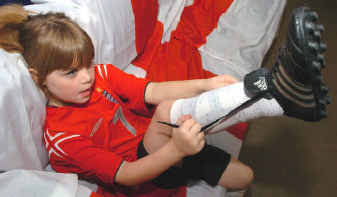
PORTLAND — When Emma Agger turned 6, her father Simon, a diehard European soccer fan, decided she was old enough to watch the game in its native habitat.
So this summer, they packed their bags in their home not far from Nike Inc.’s Beaverton headquarters and headed to Britain. There, in his hometown of Leicester, Agger found that the landscape of this quintessentially European sport had changed and become more American.
“I couldn’t even buy a child’s version of a football ball without it having the (Nike) swoosh on it,” said Agger, resenting what he sees as a U.S. company’s intrusion into a European pastime.
For decades, Adidas, founded by the German cobbler Adi Dassler, was the unrivaled leader in European soccer merchandise sales. But Nike, the world’s largest manufacturer of athletic apparel, has been making aggressive inroads.
In 1994, when the Oregon company first began courting the soccer market, its global soccer sales were $45 million. Today, industry insiders say soccer sales are hovering at around $1 billion.
Now, Britain’s top two teams — Manchester United and Arsenal — both wear the Nike uniform, as do 45 of Europe’s top clubs, compared to 41 for Adidas, the two companies say.
At the European Championship in Portugal this summer, 49 percent of the winning goals were scored by players wearing the swooshed cleats, compared to only 31 percent for those clad in Adidas boots with their trademark three stripes.
And in the most surprising reversal, Nike recently announced it had become No. 1 in soccer footwear sales in Europe, edging out Adidas in what analysts say is the most profitable category of soccer merchandise.
“For the first time ever in our history, we became the No. 1 market share leader in football — or soccer — on the European continent,” said a beaming Charlie Denson, Nike’s co-president, at the company’s annual shareholders meeting here in September.
While Nike declined to release sales figures to back up its claim, a study conducted by the market research firm NPD and cited in published reports confirmed that Nike had clinched 34 percent of the soccer footwear market in Europe last year, outdoing Adidas which is hovering at around 30 percent.
Adidas officials counter that worldwide, the German brand is the leader in the global market share. The company says its annual global soccer merchandise sales are about $1.15 billion or 34.5 percent market share, compared to Nike’s $1 billion or roughly 29.8 percent market share.
“We know that the competition is very fierce in Europe, but when we look at the global picture we’re still the market leader,” said Guenter Weigl, Adidas’ global director for football in the company’s headquarters in Herzogenaurach, Germany.
And even in Europe, Adidas still leads the pack in soccer jerseys, shinguards, balls — everything but footwear, the two companies say.
Still, Nike’s gains in a sport that has long been Adidas’ birthright have caught people’s attention.
“It’s a reversal,” said Paul Swangard, managing director of the Warsaw Sports Marketing Center at the University of Oregon. “All of the significant competitions in Europe last year were won by teams under the Nike banner — and that brings a lot of authenticity to their message.”
To many European cognoscenti, Nike’s challenge to Adidas on soccer pitches is nothing short of war.
“It ain’t over yet — and it won’t ever be over,” said London-based Dave Boyle, deputy director of Supporters Direct, an organization for soccer fans. “Nike is American and Adidas is European. Europe is not going to let its sport — soccer, or whatever you call it — roll over and go to an American company.”
“Football is in our DNA,” said Kevin Ross, U.S. soccer manager for Adidas.
Nike’s Global Brand Manager for Football Don Remlinger responds to the criticism of Adidas fans by pointing out that European consumers ultimately gave Nike its No. 1 status on the continent — many of whom are too young to remember Adidas’ heyday.
“The fact of the matter is today’s teenagers in Europe have only known a world in which Nike is a leading football brand,” he said.
Adidas executives stress that in key markets, they still have the leading soccer brand — even in the United States.
Adidas had 52 percent of the U.S. soccer footwear market last year, compared to 35 percent for Nike, according to data compiled by SportsScanINFO, a market research firm in West Palm Beach, Fla. And Adidas recently announced a 10-year $150 million sponsorship deal with the American Major League Soccer franchise.
Still, while emotions may run high for some, the battle of the brands means little to many fans.
Said Mark Longden, spokesman for the Manchester United Supporters Association, “I didn’t even really know that Nike was an American company until very recently.”