
FireSmart program helps homeowners protect property
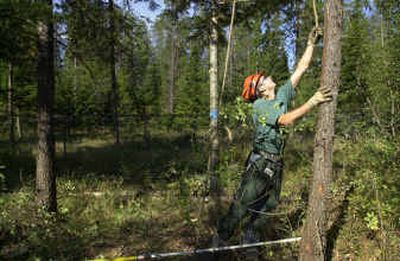
A Kootenai County prevention program is spreading like wildfire.
FireSmart, which clears flammable brush and trees from around homes near forested areas, started in 2001 and has become a highlight to Idaho’s statewide Fire Prevention Plan.
“As a homeowner, you have a choice other than squirting water on your cherished possessions,” said Larry Isenberg, project manager for FireSmart. “You can take a proactive stance.”
The program works with 14 private contractors in the area to clear out flammable brush and weeds and leave treed areas pruned 10 feet from the ground, or one-third the tree height.
He said the first cut is the most difficult and labor intensive. Crews use chain saws to cut a fire barrier about 150 feet wide around each home. Crews can clear about an acre of brush fuel a day. Once the first cut is complete, the barrier can be maintained easily with common landscaping tools or by raising animals like goats or llamas.
About 90 percent of homeowners are keeping up with maintenance, Isenberg said.
To date, FireSmart crews have cleard 2,150 acres of brush from around 2,649 structures. Much of the work has been concentrated where the teams work. When neighbors drive by, they see what’s going on and often sign up for the service.
Nationwide, an average cost to clear the hazardous fuels is about $1,200 an acre. Kootenai County averages about $730 an acre.
In some areas of Kootenai County, up to 70 percent of a neighborhood has been cleared by FireSmart.
“All these homes, no matter how good the fire districts are, those homes all have to stand on their own for a certain amount of time,” said Mike Denney, area supervisor and fire warden with the Idaho Department of Lands and one of the FireSmart founders. “That’s what this treatment does. It buys us that time.”
He said the brush clearing is “great insurance” and has been proven in fires in other states and recently in Coeur d’Alene.
Before the program started, a similar firebreak on Tubbs Hill helped keep an arson fire from getting out of control until fire crews could arrive. Poor access increased response time, but the fire burned slowly and was put out before it would sweep over the hill, Denney said.
“It’s not a guarantee, but when you have large-scale fires and everything’s black and there’s a survivable house in the middle, you can walk around and see why,” he said.
FireSmart is funded through the Idaho Fire Plan Working Team, which meets quarterly to place the grant dollars. The team includes members of the Idaho Department of Lands, the U.S. Department of Lands and the U.S. Forest Service. The group met last week to share successes and hear a presentation on FireSmart. The meetings included a four-hour tour of sites affected by the program.
Brian Shiplett, chief of fire managment for the U.S. Department of Lands office in Coeur d’Alene, attended the meetings last week.
“All the agencies affected by wildland fire on a statewide basis were in the same room and in agreement,” he said. “That doesn’t always happen when you have different governmental groups working together.”
But even with FireSmart gaining a strong foothold in Kootenai County, Shiplett said numerous homes remain unprepared.
Of the 13 Western states, each except Idaho and Wyoming has faced a major wildland fire near urban areas in the last few years.
“When it does, it’s going to catch a lot of folks’ attention,” he said.