
Fraud charges cloud Afghan vote
KABUL, Afghanistan – Three years after the fall of the Taliban, Afghans voted in massive numbers Saturday to elect their president for the first time. But the historic and largely peaceful poll quickly fell under a cloud of uncertainty as 15 candidates alleged irregularities and fraud and said they would deem any result “illegitimate.”
The dispute centered on the supposedly indelible ink applied to voters’ thumbs to prevent them from casting ballots more than once. In many precincts, voters said, washable ink was used or indelible ink was applied improperly, allowing the marking to rub off easily and opening the door to repeat voting.
“It’s Afghanistan’s hanging chad,” said Maj. Gen. Eric Olsen, the operations commander for U.S. and coalition forces in Afghanistan who coordinated an extensive and apparently successful security operation to counter bomb plots and other attacks threatened by militants still loyal to the Taliban.
The argument over the ink threatened to dash hopes for national unity after more than two decades of war and chaos. It also could be a setback for the United States, which has 18,000 troops in Afghanistan and has invested heavily in turning the country into a democratic state since invading in fall 2001.
International officials, including U.N. Special Representative Jean Arnault and U.S. Ambassador Zalmay Khalilzad, sought to play down the controversy and stress the widespread participation and near absence of violence.
Khalilzad late Saturday said that all candidates have a duty to respect the results, win or lose.
“The responsibility of all candidates is not to raise allegations of wrongdoing intended solely to paralyze the democratic process,” he said. “For Afghanistan to win, the losers in the election should not undermine the achievement of the Afghan people.”
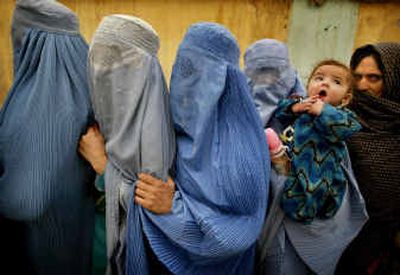
Given the country’s primitive infrastructure – some villages are accessible only by mountain footpaths – and election workers’ lack of experience, counting of ballots was expected to last as long as three weeks. More than 10 million people had registered to vote, and large and enthusiastic crowds lined up in long, snaking queues at many polling stations.
But even before the first ballot was cast, there was widespread expectation that the victor would be incumbent Hamid Karzai, who was chosen as interim president in December 2001 by a small group of Afghans at talks in Germany, then renamed to the post by a national conference the following year.
Karzai, an ethnic Pashtun aristocrat who has enjoyed U.S. backing over the past three years, has been hoping the election would give him a popular mandate to rein in the warlords and drug lords who hold sway in much of the country outside the capital, Kabul.
At an evening news conference, he rejected complaints from the 15 challengers that the election was irreparably tainted.
“The election was free and fair,” Karzai said. The millions of Afghans who voted should be enough to rebuff the complaints, he said, “because in the dust and snow and rain, they waited hours and hours to vote.”
The joint U.N.-Afghan election body overseeing the vote refused the 15 candidates’ calls to halt the voting and declare the election void. But officials promised to thoroughly investigate the complaints in coming days.
“Given the complexities of this electoral process, there have inevitably been some technical problems,” a spokesman for the Joint Electoral Management Body conceded in a statement. Nevertheless, “The voters of Afghanistan have turned out in large numbers and … the process overall has been safe and orderly.”
“Halting the voting at this point is unjustified and would deny … individuals their fundamental right to vote,” the election body added.
Challenges ahead
Determining the extent of the problems could be difficult, given that only about 230 international observers were present for the polls nationwide. Another 16,000 Afghan observers monitored the vote, but 75 percent of them were partisan political operatives.
In the worst case, if the $200 million elections were to be declared void, it would be a financial catastrophe and might call into question the fragile accord that has kept the country in a state of relative peace and stability for three years.
The 15 candidates who said they would reject the results included Karzai’s chief rival, former Education Minister Yonus Qanooni, an ethnic Tajik and veteran mujahedeen fighter who has sought to win support from his ethnic group and from veterans of the 1979-‘89 fight against Soviet occupation, the civil war of the early 1990s and the resistance to the Taliban in the late 1990s.
Candidate Abdul Sater Sirat, a Pashtun professor of Islamic literature who hosted a gathering of Karzai’s opponents at his home Saturday, said: “Any government as a result of this election is not legitimate.”
Sirat had failed in discussions among the candidates before the election to forge an anti-Karzai alliance. But the group quickly united and pounced Saturday on the complaints over the ink.
Other allegations
Amid widespread concern that many people had registered to vote several times and received multiple registration cards, use of the indelible ink was considered critical to prevent repeat balloting.
But Karzai’s foes raised other concerns as well. Sirat cited accusations that police and local officials in several areas were coercing people to vote for Karzai, and that ballot papers and polling stations had been inadequate or missing elsewhere.
Another anti-Karzai candidate, Abdul Latif Pedram, a Tajik poet and intellectual, broadened the criticism by alleging the entire election had been manipulated by the United States to ensure a Karzai victory. His comment reflected resentment among some politicians that Khalilzad, the ambassador, appeared to endorse Karzai on occasion and act as his manager.
Asked about such allegations last week, Khalilzad denied them and insisted Washington, D.C., would support whoever won. Told about Pedram’s comments Saturday, a U.S. official laughed: “The Afghans voted today. The United States did not vote.”
President Bush, campaigning Saturday in Waterloo, Iowa, hailed the election. “A really great thing is happening in Afghanistan,” he said. “The people of that country, who just three years ago were suffering under the brutal regime of the Taliban, are going to the polls. … Amazing, isn’t it? Freedom is beautiful.”
To win, a candidate must capture 50 percent of the vote; otherwise a runoff is to be held between the top two vote-getters.