
Hispanics missing from prime time
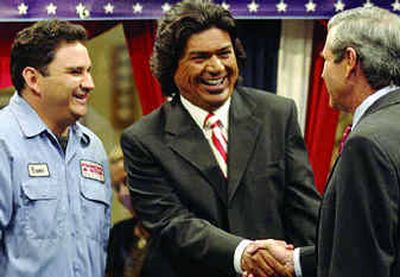
When the “George Lopez” show began its fourth season on ABC last month, it was the only prime-time television program featuring a cast dominated by Hispanic actors.
Unusual? Hardly. Although they make up the nation’s largest minority group and represent a consumer market worth an estimated $700 billion, Hispanics are rarely seen on America’s television sets.
“Hispanics remain the most underrepresented group on prime-time television,” says Patti Miller of Children Now, a California-based group that annually tracks diversity on prime-time TV.
The group’s latest study shows that Hispanics – who number 40 million and make up 13 percent of the U.S. population – represent fewer than 7 percent of actors appearing on prime-time television shows on the six major networks.
That angers Hispanic lawmakers, including Rep. Joe Baca, D-Calif., who is pressing the television industry to diversify its programming and the people it hires to work on the air and behind the scenes.
“It’s time that Hollywood looked like the rest of America,” he said at a congressional hearing he organized last month to call attention to the issue.
He wants to summon network executives before Congress by the end of the year to explain why they’re not doing more to include Hispanics in their programming and hiring decisions.
Network executives say they are making progress. ABC, NBC, CBS and Fox pledged four years ago to hire more minorities on and off camera and created separate company divisions to promote diversity and seek minority talent.
As a result, the proportion of Hispanic characters on prime-time television rose to 6.5 percent in 2003, up from 4 percent in 2001, Children Now found.
“Diversity is critical to our business strategy,” said Peter Chernin, chairman and CEO at Fox.
Experts say the TV industry’s lack of interest in shows featuring Hispanics in prominent roles gives Hispanics, especially children, a sense that they’re undervalued.
They also argue that “George Lopez,” which drew 6.1 million viewers for its season premiere, and the animated Nickelodeon show “Dora the Explorer” – the most-watched television program among preschool children, with a weekly audience of 21 million – prove that shows with Hispanics in prominent roles can be successful.
On Monday, PBS premieres the animated “Maya & Miguel,” featuring bilingual, bicultural Hispanic twins and an extended family that includes a Puerto Rican father and a Mexican mother. (It will air weekdays at 3 p.m. starting Monday on Idaho Public Television – including KUID-12 in Moscow and KCDT-26 in Coeur d’Alene – and is scheduled to begin in January on KSPS-7 in Spokane.)
Deborah Forte, president of Scholastic Entertainment and the show’s executive producer, said “Maya & Miguel” reflects the changing face of America.
“Maya and Miguel are Americans and they are Latinos,” she said. “All kids are going to see themselves in the show.”
But Hispanic TV viewers say too many shows stereotype them as underachievers.
Xochitl Calderon, a Salinas, Calif., mother of two, said she recently had to explain to her 11-year-old son that Latinos are not all alcoholics.
“We were watching a sitcom, and the only role for a Latino was of a drunk man,” Calderon said. “The boys are young, and this kind of stuff sticks in their heads. And it’s also in the movies: We always are the maids, the prostitutes or the gang members.”
Experts say increasing the presence of Hispanics on television won’t be easy. They say TV network and cable executives still perceive Hispanic-dominated programs as having little appeal beyond the Hispanic community, and those executives tend to have little understanding of U.S. Hispanic culture.
“Some feel that Latino characters are hard to sell because they don’t believe they add anything to a show,” said Clara Rodriguez, a Fordham University sociology professor and expert on Hispanics and the media.
Rodriguez said NBC’s mega-hit “Friends” sitcom typified the network’s reluctance to add Hispanic characters. Set in New York, a city where minorities outnumber whites, the show rarely included minorities.
Alex Nogales, CEO of the National Hispanic Media Coalition, the television industry is making “incremental progress.”
He said NBC, for example, did not have a single Hispanic writer four years ago when the coalition and other minority groups began pressuring the networks to hire more minorities. The network now has six Hispanics among its 130 writers.
“Now, of course, having six out of 130 writers isn’t great, but it’s far better than zero,” Nogales said.