
Interim Somali president tapped
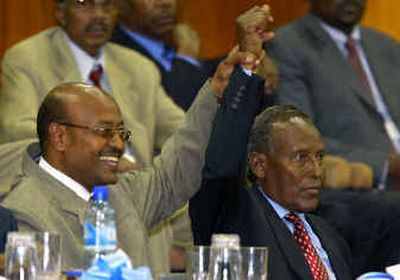
NAIROBI, Kenya — Members of Somalia’s transitional parliament on Sunday elected a former army colonel as interim president, the final stage of a peace plan meant to end 13 years of civil war in the Horn of Africa nation.
Col. Abdullahi Yusuf won with 189 votes in a third round of voting, Shariif Hassan Sheikh Aden told the 275-member transitional parliament and regional foreign affairs ministers, who observed the vote.
Former Finance Minister Abdullahi Addow garnered 79 votes in the last round, which narrowed the race to two candidates after none of the original 28 won a majority, said Aden, the parliament speaker.
The vote was held in Kenya because of a lack of security in Somalia, where the country is divided into fiefdoms controlled by warlords. Thousands of people have been killed in the war.
“Some Somalis work during the day and others during the night, but I promise to you that I will work both day and night to make Somalia secure,” Yusuf said in an impromptu acceptance speech.
Somalia has had no government since 1991, when warlords overthrew dictator Mohammed Siad Barre and turned their guns on one another, dividing the country of about 7 million people.
Yusuf, 70, served in the army under Barre, rising to the rank of colonel. In 1978 he formed the first group to oppose Barre, the Somali Salvation Defense Front, which was crushed by the dictator. Yusuf then fled to Ethiopia.
Addow conceded defeat and pledged his cooperation with the president-elect.
“I wish him success in his new job,” Addow said. “I promise before the Somalis and the international community that I will work with the new president of Somalia.”
Yusuf will nominate Somalia’s prime minister, who then will name a Cabinet. The members of the transitional parliament have an unwritten agreement to fill key government and legislative posts along clan lines.
Yusuf is a member of one of Somalia’s four biggest clans, the Darod. He is expected to choose a prime minister from another big clan, the Hawiye, which controls Somalia’s capital, Mogadishu.
In August, long-running peace talks in Kenya resulted in the formation of a transitional parliament. Aden was elected speaker Sept. 15.
Somali leaders and European diplomats close to the talks have complained that the United States has not been involved enough in the peace process.
U.S. policy on Somalia remains tainted by the Battle of Mogadishu in 1993, when 19 U.S. soldiers were killed by militiamen and U.S. troops were unceremoniously withdrawn from the U.N. peacekeeping operation at the time.
Many diplomats and activists point out that there has been little reconciliation in the peace process among enemies, who now sit together in parliament and run against each other for government posts.
The new government will take over a country that has no civil service, no public property and no money.
European officials are working on a proposal behind the scenes to give the new government $17.5 million. Privately, some European officials acknowledge the aid is not enough.
The United Nations has estimated that at least $5 billion will be needed to rebuild Somalia in the long term.