
Bridge
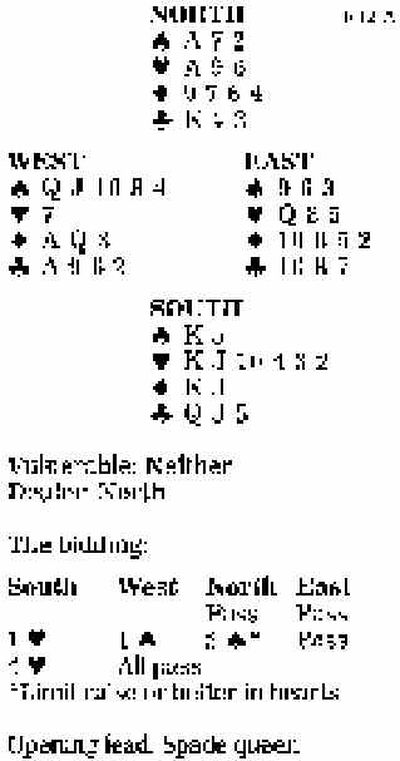
When West makes a one-spade overcall, North could make a negative double, but it looks better to cue-bid, showing a sound raise to three hearts. This agreement allows a jump to three hearts in competition to be pre-emptive. Playing this style, South has enough to jump to game.
In four hearts, on the lead of the spade queen, South wins the king and ace of spades and ruffs the spade loser in hand. Then he leads the club queen to knock out the club ace. West is forced to win and can exit safely only with another club. South wins the club jack, cashes dummy’s heart ace, and then takes the club king. (On a bad day West might ruff the third club, but if he did, there is a fair chance he would have no trumps left and thus be compelled to lead away from the diamond ace or to concede a ruff and discard by playing spades.)
As it is, when the club king lives, the key play follows. South leads a second trump from dummy and, when East follows with a low heart, finesses the heart jack, a “heads I win, tails you lose” play. If the finesse wins, South is safe; he must give up two diamonds, but has 10 tricks. If the finesse loses, West will be out of hearts and must open up the diamonds or give South a ruff and discard. Either way, South is home free.
Bid with the aces
South holds:
| •A 7 2 | |
| •A 9 6 | |
| •9 7 6 4 | |
| •K 4 3 |
| South | West | North | East |
| Pass | Pass | ||
| ? |
Answer: Pass, and do not open one diamond. In third seat, if you open marginal hands, it should be because you are going to help partner with the defense. Here the effect of bidding diamonds will be to overstate your high cards, misdescribe your hand, and get partner off to the wrong lead on defense. A trifecta like this may make a good bet in other sports, but it would be something to avoid in bridge.