
Bridge
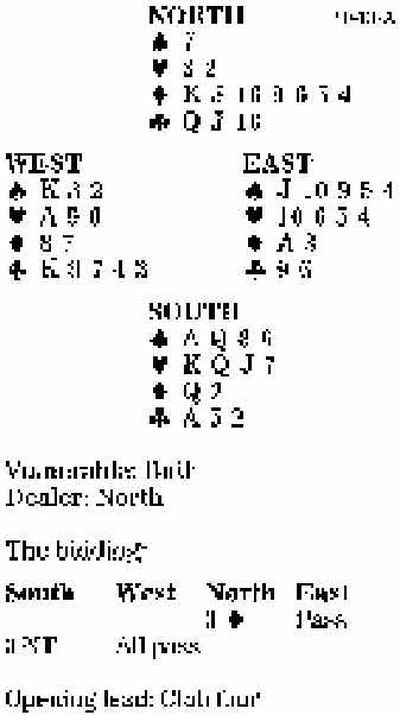
When North opens a vulnerable pre-empt in first seat, South has no reason to introduce a four-card major. There is little chance of finding a 4-4 fit, and when no-trump looks like the right destination, you are better off just bidding it rather than trying to make partner’s life difficult for him.
In three no-trump dummy’s diamonds are a disappointment, but there is the compensation in the form of a side-suit entry to dummy – so long as you are suitably careful at the first trick! When West leads a club at trick one, South could win cheaply, but doing so would cost him the contract. Instead, South must win the first trick with his club ace, leaving himself with small clubs in hand and thus a guaranteed eventual entry to dummy in clubs.
South’s next move is to establish the diamonds. He leads the diamond queen from hand and follows up with his small diamond when the queen holds the trick. East wins the second round of diamonds and shifts to the spade jack. South carefully takes his spade ace, rather than finessing, since putting in the spade queen would be jeopardizing the contract for an overtrick. Next South plays a club up to dummy’s queen to build an entry to dummy. West can go in with his club king and has a heart and spade trick coming to him, but no more. Whatever West does, South gets his nine tricks.
Bid with the aces
South holds:
| •K 3 2 | |
| •A 9 8 | |
| •8 7 | |
| •K 8 7 4 3 |
| South | West | North | East |
| 1 • | 1 • | ||
| ? |
Answer: Bid two diamonds to show a high-card raise to at least three clubs. These days a jump to three clubs would promise more in shape and less in high cards, the cue-bid replacing the old-fashioned limit raise. If East had doubled one club, a jump by you to two no-trump would be the way to show the limit raise.