
Bridge
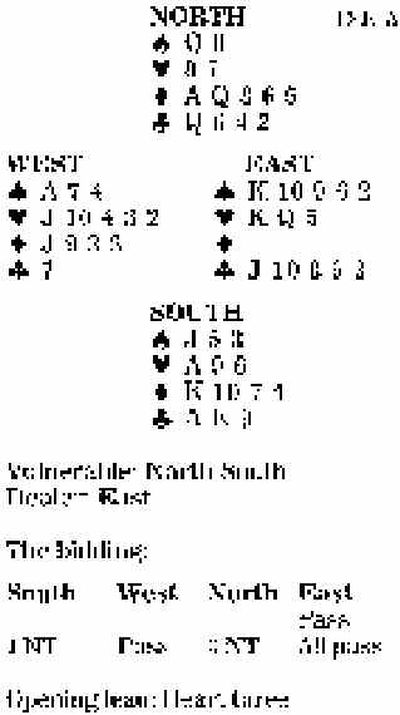
Playing in three no-trump, you receive the lead of the heart three to East’s queen. Since there is no immediate hurry to take the trick, you duck it, as well as East’s continuation of the heart king, and take your ace on the third round. West had followed with the heart two on the second round of the suit, so you are inclined to assume that he began with five hearts and East with three. You have seven top tricks only, but as long as diamonds behave, there is no problem.
However, given that you can guard against a 4-0 diamond split on either side, which player is more likely to hold length in diamonds? The simple play would be to lead to dummy’s diamond queen, but the alternative would be to start with your king and take two finesses against West. As it happens, you do not have to commit yourself at once. Instead, cash dummy’s club queen and then lead to the club ace. If both players follow to these two tricks, it will be logical to play West (the player with long hearts) for the diamond shortage.
When West shows out on the second club, then if anybody is going to be long in diamonds, it will be him. Accordingly, you should cash the diamond king next. When the bad split comes to light, you run the diamond 10, covered all around. That will allow you to cross back to the club king to repeat the diamond finesse and take nine tricks.
Bid with the aces
South holds:
| •K 10 9 6 2 | |
| •K Q 5 | |
| •—- | |
| •J 10 8 5 3 |
| South | West | North | East |
| 1 • | Pass | ||
| 1 • | Pass | 2 • | Pass |
| ? |
Answer: Bid only two hearts. This is not nearly as good a hand as it looks. Being short in diamonds is not that positive a feature; you will be taking diamond ruffs with trump tricks, and your black honors could be worth nothing at all, facing shortage.