
Revolutionary icon of choice
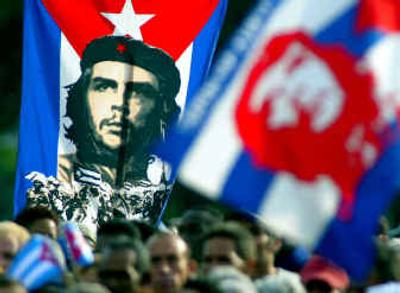
He’s big in Hollywood. He’s an international fashion icon. He’s collectible.
Today, 37 years after his execution, the enduring image of Marxist guerilla leader Ernesto “Che” Guevara is of a man with the ideal face for a T-shirt.
Sales of Che-adorned merchandise – which includes belt buckles, caps, cigarette lighters, cuff links, drink coasters, handbags, key rings, place mats and watches – is getting a boost from the new movie about the pre-combatant Guevara, “The Motorcycle Diaries” (which opens Friday in Spokane).
Robert Redford was an executive producer for the film, which stars Gael Garcia Bernal as Guevara.
Guevara’s legacy is intensely controversial. Born in Argentina and educated as a doctor, Guevara was a commander in the insurrection that led to Fidel Castro’s takeover in Cuba. He later fought against the Bolivian military, who captured and killed him.
From one political perspective, he was a martyr for social justice. From another, he was a ruthless, United States-hating killer.
Either way, what Guevara rejected in life has defined him in death: capitalism.
For decades now, if it’s Che, it’s chic. These days, he’s usually in the running for revolutionary icon of choice in eBay sales, and his trendiness has inspired such head-spinning manifestations as a large tattoo of his visage on boxer Mike Tyson’s rib cage. Guevara tie-ins are also being used to promote tourism in Bolivia.
Much has been made over the decades about the visual potency of a particular Guevara image – a photograph considered among the most famous ever taken.
Snapped by the late Alberto Diaz Gutierrez (better known as Albert Korda), the photo immortalized the beret-wearing Guevara as the epitome of the revolutionary spirit. Its inspirational appeal is often said to overpower any need to understand who Guevara was or what he did.
“It looks like Saint Che on the image. It conveys determination, seriousness, dedication and charisma,” says Saul Landau, a political scholar and documentary filmmaker who met Guevara in 1960 in Cuba.
Landau, 68, is director of digital media and international outreach programs for the College of Letters, Arts and Social Sciences at California State Polytechnic University-Pomona.
He echoes what fierce Guevara admirers say about all the T-shirts and paraphernalia – that “Che would roll over in his grave” – but adds, “and then he’d probably laugh.”
Canadian photographer John Trigiani, who created a Web site selling a multiplicity of Guevara-themed merchandise ( www.thechestore.com), says he has a core of highly educated buyers who are well informed about Guevara’s life.
But he also says there’s tremendous interest from consumers who are reacting to the commercial popularization of the image.
“I sell stuff to college students who have no idea who he is,” said Trigiani. “They think he’s the lead singer for Rage Against the Machine (the band that put the Korda portrait of Guevara on the cover of their first album).”
Sales rise, says Trigiani, when something like Tyson’s tattoo or rapper Missy Elliott’s Che cap get media exposure.
He pays close attention to all Guevara-related news – including the reported plans for a big-budget movie that would star Benicio Del Toro – and wants to expand his Web site to add messaging and other social features for the “community” of Che fans.
To Trigiani, Guevara’s legacy is not hard to analyze.
“Basically,” he says, “Che’s a rock star.”