
New lava emerges behind old dome

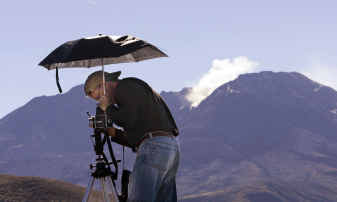
SEATTLE — More new lava emerged on the crater floor of Mount St. Helens on Thursday, expanding the growing rock formation behind the volcano’s old lava dome and emitting a red glow at night.
Airborne observers have seen “vigorous jets” of ash and steam near the new growth, said Tina Neal of the U.S. Geological Survey. Aerial photographs suggest some uplift on the left side of the emerging rock “fin.”
Temperatures on parts of the new lobe exceed 1,300 degrees Fahrenheit, and feathery ash blankets red-hot stone.
Dimensions of the new lobe building on the existing lava dome have not been pinned down due to steam and fumes at the site, Neal told a news conference at the Gifford Pinchot National Forest headquarters in Vancouver, Wash., about 50 miles south of the mountain.
“It’s grown a little bit since Monday” to about 1,600 feet in diameter and 400 feet high, Neal said. Because the crater floor slopes downward to the north, the new formation on the higher south side is about level with the 1,000-foot top of the old dome.
Seismic activity remained low Thursday, suggesting “an open system” that allows magma to reach the surface without significant obstacles, she said.
This period of dome-building began with intense seismic activity Sept. 23, which indicated magma was breaking through rock as it rose toward the surface. Several steam eruptions followed, and geologists detected lava at the surface late Monday.
The last round of dome-building began in the months after St. Helens’ devastating May 1980 eruption and lasted six years.
Gas-rich magma can cause explosive eruptions, but samples taken this week have detected little carbon dioxide or hydrogen sulfide at the site, Neal said. There was no evidence, including increasing earthquakes or ground deformation, to suggest pressure was building, she said.
So far this fall, the most visible bursts at St. Helens have involved steam and small amounts of ash as rainwater and glacier melt combined with hot rock in the crater of the 8,634-foot peak.
As the dome-building continues, it could produce small explosions with little warning, Neal said.
A large explosion is still possible, but is among the least likely scenarios, she said. Such a blast could send a column of steam and gritty ash tens of thousands of feet up and out, posing potential problems for airplanes and road traffic.
Trails within a five-mile radius of the peak remained closed, with the alert level at a mid-range “volcano advisory.” The Forest Service, however, reopened some roads and trails near the mountain for hunters and hikers, including the popular Ape Cave and Trail of Two Forests on the mountain’s south side.