
Bush, Kerry say the other is very scary

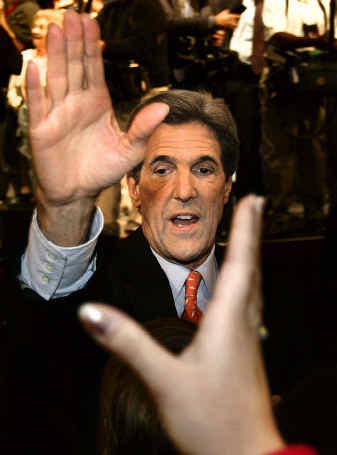
ST. PETERSBURG, Fla. — Scare talk shivered through the fast-closing presidential campaign Tuesday.
John Kerry’s campaign accused Republicans of trying to frighten voters about a terrorist attack being more likely if the Democrat is elected. President Bush said Kerry was plunging into the “politics of fear.”
Vice President Cheney, campaigning in Carroll, Ohio, suggested Kerry wouldn’t be tough enough to defeat the “ultimate threat” of terrorist attacks on U.S. cities with nuclear, chemical or biological weapons.
“You’ve got to get your mind around that concept,” Cheney said. Although Kerry wants voters to think he’d fight terrorism as aggressively as Bush, Cheney said, “I don’t believe it.”
Mark Kitchens, Kerry’s national security spokesman, said Cheney “wants to scare Americans about a possible nuclear 9/11, while the Bush administration has been on the sidelines while the nuclear threats from North Korea and Iran, the world’s leading sponsor of terrorism, have increased.”
Kerry stepped up charges that inaction by Bush contributed to a shortage of flu vaccine. “If you can’t get flu vaccines to Americans, how are you going to protect them from bioterrorism?” Kerry said in a radio interview with National Public Radio.
The president told 10,000 supporters in a park here that the federal government is “doing everything possible” to help higher-risk older Americans and children get vaccinated.
Bush has accused Kerry of “weakness” on terrorism and Iraq. Kerry plans to return to national security in a speech today in Waterloo, Iowa, but in northeastern Pennsylvania on Tuesday, he stuck to Social Security and budgetary restraint.
In Wilkes-Barre, a Democratic-leaning city, many older voters are social conservatives and economic liberals who cherish the New Deal and its creation of Social Security. Kerry said Bush threatens the future of the retirement program. Bush is “the first president to launch an all-out assault on Social Security since FDR signed it into law,” Kerry said.
Bush proposes to allow younger workers to invest some of their payroll taxes in personal retirement accounts. Kerry, as he often does, called this a plan to “privatize” Social Security and said it could cut government benefits 23 percent to 45 percent.
“On Nov. 2, Social Security is on the ballot,” he said. “A choice between one candidate who will save Social Security and another who will undermine it.”
Bush denounced as false suggestions from Kerry that he would cut Social Security for seniors or reinstate the draft. “On November the 2nd,” Bush said in The Villages, Fla., “the people of America will reject the politics of fear and vote for an agenda of hope and opportunity and security.”
Independent observers have criticized Kerry for failing to specify how he would protect Social Security. He answered this Tuesday, tying the issue to his previously announced proposals for cutting federal budget deficits. Kerry’s plan includes cutting corporate tax breaks, restoring automatic caps on non-defense spending, implementing a policy that identifies a funding source for every new proposal, going after “bloated government contracts” and giving the president line-item veto authority to kill pork-barrel projects.
Steve Schmidt, a Bush spokesman, responded, “Only John Kerry could claim that his proposals of at least $2.2 trillion in new government spending are fiscally responsible.”
The Kerry campaign says its spending proposals add up to $1.2 trillion and are offset by an equal amount in budget reductions, including $860 million from a rollback of Bush’s tax cuts for the highest brackets.
While most of the attention fell to the president, his rival and their running mates, a GOP-aligned group, Progress For America Voter Fund, announced plans to spend $14 million over the campaign’s final two weeks on a feel-good ad about Bush’s wartime leadership.
In it, Ohio teenager Ashley Faulkner recalls Bush comforting her after her mother died in the terror attacks of Sept. 11, 2001.
“He’s the most powerful man in the world and all he wants to do is make sure I’m safe, that I’m OK,” she says.
Meanwhile, a broadcasting company said a documentary critical of Kerry’s anti-Vietnam war activities will be shown only in part on Friday on 40 of its 62 stations, during a program examining how such films are used to influence elections. Sinclair Broadcast Group Inc., which has been criticized for ordering its stations to pre-empt regular programming to air the documentary, said reports that the film would be aired in its entirety were “inaccurate.”