
Bridge
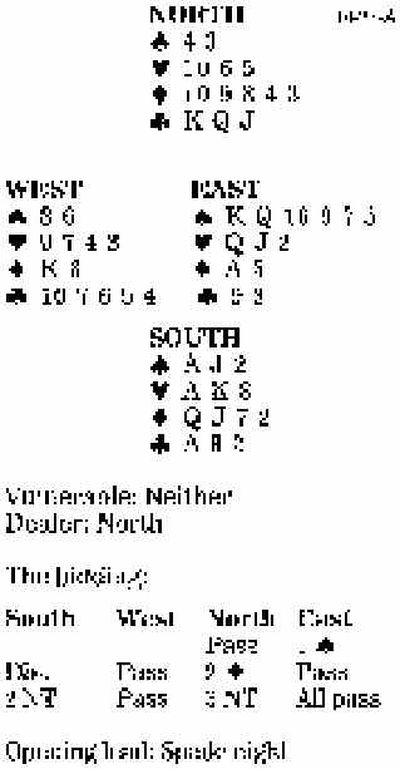
Assuming perfect play, which side would you back in this three-no-trump contract with a spade lead, the defense or the declarer? The deal comes from “Kantar on Kontract.” As a side-bar, South’s sequence of doubling first and then bidding no-trump shows a stronger, not a weaker, hand than a direct one-no-trump overcall. With 12-14 balanced, you would pass at your first turn, of course.
I hope you put your money on the defense. However, in order for them to prevail, East must not play a spade honor at trick one. He knows that West’s eight shows a doubleton spade – with three small spades West would have led a low spade. Thus declarer has a double guard in spades. When East plays the nine, South wins the jack and attacks diamonds. However, as long as West wins the first diamond and continues a spade, driving out South’s ace, declarer has no chance. East will be left with a bunch of winning spades and the diamond ace for an entry.
If East plays a high spade at trick one, South ducks, wins the spade continuation with the jack, and attacks diamonds. Since West has no more spades when he gets in with the diamond king, South has time to drive out the diamond ace while retaining a spade stopper.
It is not a bad rule for the defense to try to force declarer to win the first trick in their side’s suit, if they can do that without costing themselves a trick.
Bid with the aces
South holds:
| •A J 2 | |
| •A K 8 | |
| •Q J 7 2 | |
| •A 8 2 |
| South | West | North | East |
| 1 • | Pass | 1 • | Pass |
| 2 NT | Pass | 4 NT | Pass |
| ? |
Answer: Bid six spades. Partner’s four-no-trump call is not Blackwood, but shows an invitation to slam. Since you have a maximum, you should drive to slam. On the way to six no-trump, suggest to partner that spades might be the right place to play, in case he has five spades in a balanced hand.