
Fiber-optic gets boost
NEW YORK — For at least a decade, phone companies have been promising to rewire America with fiber-optic cables. Now, with a romp of regulatory victories in hand, the regional Bells say they’re free to make good on that ambitious plan to bring lightning-fast Web and TV services to all the nation’s homes.
In recent days, the nation’s three biggest local phone companies announced plans to expand their fiber deployments, an endeavor that may take years to pay off for Verizon Communications Inc., SBC Communications Inc. and Bell South Corp.
Some analysts wonder whether the companies can even afford the tens of billions of dollars it will cost to replace the copper in their networks. Further, the Bells will need to secure good enough terms on TV programming and lure enough customers from cable and satellite operators to justify the investment.
Skeptics also worry that government regulation may yet be used by the Bells as an excuse to stall.
But with cable TV and cellular companies offering their own phone and broadband services, the Bells maintain it’s out with the copper, and in with the fiber.
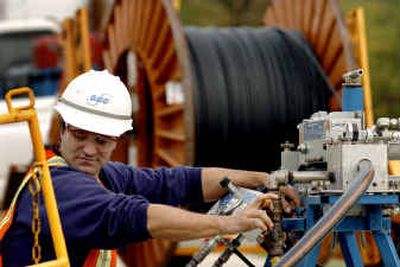
To that end, Verizon announced Thursday that six more communities in three states are being offered its new fiber-based Internet service, first introduced to the Dallas suburb of Keller in August. Verizon also said fiber is now being installed in communities in nine states encompassing about 700,000 homes and businesses.
And to further demonstrate its resolve, Verizon said it is hiring 5,000-to-7,000 people for the job and negotiating with content providers to introduce TV and video services by sometime next year.
A day earlier, SBC said it had placed a $1.7 billion order with Alcatel SA of France for network equipment and video system integration services.
Those announcements came about a week after the Bells responded to favorable rulings by the Federal Communications Commission — including one widely reported decision that has yet to be confirmed — by stepping up their commitment to fiber.
SBC said its deployment, budgeted at $4 billion to $6 billion, would deliver advanced services to 18 million households within three years rather than five as previously announced. BellSouth, which leads its peers with fiber already strung to the curb at 1.1 million homes, said it was increasing next year’s deployment by 40 percent to about 180,000 homes.
Verizon stood by its projection to reach about 1 million homes at a cost of $800 million and another 2 million homes in 2005, though anecdotal evidence suggests it, too, has picked up the pace.
“Every discussion we’ve had with people close to (Verizon’s) project indicate they are moving, and moving faster than the publicly announced plans,” said Albert Lin, industry analyst for American Technology Research. “Contractors working on that program are making installations of equipment that would not make sense to install unless you were planning to introduce service.”
Only Verizon’s blueprint actually calls for the fiber to stretch right into the home. The plan at BellSouth is to bring fiber to the curb, or within about 500 feet of most homes, and then complete the connection over the existing copper lines. SBC wants to extend fiber to the neighborhood, or within about 5,000 feet of homes before handing off to copper.
Verizon’s approach is by far the most expensive — costs may range from $800 to $2,500 per home — but could theoretically deliver hundreds or thousands of times the amount of bandwidth allowed by today’s copper wires.
The route chosen by SBC and BellSouth represent a compromise between cost, deployment time and bandwidth.
It’s also a bet that advances with DSL technology will let them shoot their signals across a shorter expanse of copper with enough speed to handle multimedia and interactive video. But it also gives them more time to ensure that the regulatory coast remains clear.
Yet while all three companies are definitely digging up more cables and restringing more telephone poles than ever before, doubts remain.
To begin with, if the Democrats manage to recapture the White House in November, the FCC might tilt back toward forcing competition by requiring the Bells to lease their local lines to rivals like AT&T Corp. at low government-set rates.
The Bells would likely slam the brakes on their investment with a return to that policy: Given a choice of local phone providers for the first time, nearly 20 million homes and small businesses switched their service from the Bells between 2002 and early 2004.
The regulatory tide turned in March with a court decision that threw out the line-sharing process. The FCC has since voted twice to protect different types of fiber deployment from any sharing obligations, and a third such decision has reportedly already been made.
Some skeptics contend that rewiring the nation will cost so much that even the Bells’ newfound regulatory confidence isn’t enough to justify the investment.
SBC, BellSouth and Verizon are all heavily in debt and pouring money as it is into upgrading their wireless operations with advanced technologies that would compete at least partly with the services to be delivered over fiber.