
Silent enemy No. 1
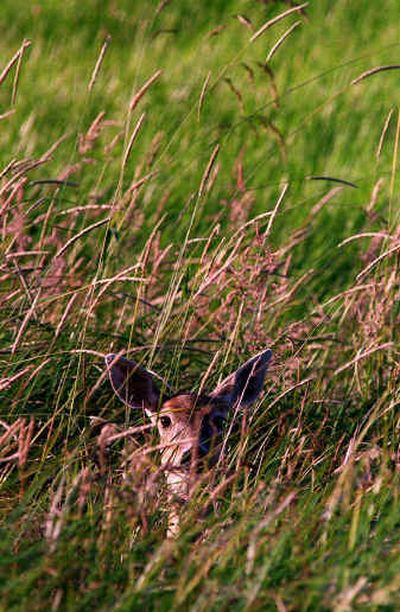

First, one materialized out of the underbrush, then a second and yes, a third. They stepped cautiously onto my back lawn. Pretty soon mom appeared out of nowhere and began leading them to some choice browsing plants. Right on schedule, the whitetail doe that has had either twins or triples the last four or five years running, introduced her fawns to my back yard this summer. I don’t mind either. I know however, that my philosophy and methods of dealing with deer and gardens does not work for everybody.
As our region grows and more people move to the urban fringes or to rural areas, conflicts between gardeners and deer will continue to increase. Not only are people moving into deer habitats, but by some estimates the deer population itself is growing. Factors such as mild winters that are easy to survive and changes in habitats because of fire, development or drought have allowed deer populations to grow. This is the case on my place in the Painted Hills in the Spokane Valley where we have lived since 1977. It wasn’t until 1992 after firestorm that we started having deer problems.
So just what is it about deer that make them such pests? “Deer are opportunists,” said Madonna Luers, public information officer for the Eastern Washington District Office of the Washington State Department of Fish and Wildlife. “They will take advantage of any easy opportunity to find food, water and shelter.”
According to Luers, there are two types of deer in our region, mule and whitetail; with whitetails being the most common by far. Whitetails are very adaptable animals that will take advantage of every easy opportunity. As a result, they have become very tolerant of human activity and presence.
In my yard, deer will move out of the way when we drive in but usually don’t go more than 15 or 20 feet away. We can slam car doors, unload groceries and talk in normal voices without so much as a twitched ear of concern from the deer. As soon as we go inside, they come right back to the apple tree and pick up where they left off.
Deer are what wildlife biologists call browsers. That means that they move through vegetation nibbling a branch tip here and a tender leaf somewhere else as they go, regardless of whether it is native vegetation or a prized rose. While they have preferred foods, they will sample anything. This is especially true of young deer just learning what is edible.
Most deer prefer to stay away from human activity when given a choice, so as long as there is food available in the wild, they will eat that first before they move into yards and gardens. In our region that means as long as there is tender green browse in the woods, they will stay there for the majority of the food.
However when the wild browse begins to dry up in mid-July, they start eyeing that nice green all-you-can-eat buffet we planted and carefully watered for them.
When that happens, it translates into Luers’ No. 1 rule about deer: There is no such thing as deer-proof anything. Some plants are just a little less preferred than others. “The only plant I have found they definitely don’t eat is daffodil.”
Because deer adapt quickly to changes in their environment, there is no single method to keep them out of our plants. “The closest thing to making a garden deer-‘proof’ is to build a tall fence around the entire garden,” said Luers.
Fences can be made of wood, wire mesh or heavy black plastic netting, which looks like a giant version of the bird netting used on fruit trees. The fence needs to be put up on sturdy posts or tied securely to trees. Because deer are incredibly good jumpers, the fence will need to be at least six feet tall and maybe as high as eight. It must be staked down carefully because what deer can’t jump, they can crawl under.
However fences are not always practical or desirable. Other methods have to be applied.
Deer have incredibly sensitive senses of taste and smell. Many of the commercial deer repellants capitalize on this and incorporate substances such as garlic, very hot pepper oil, rotten eggs or blood in their products. Garlic and hot pepper repel by taste. Rotten eggs and blood repel by smell. The hydrogen sulfide (rotten egg smell) given off by the eggs is repulsive to most deer. Blood-based repellants repel by both smell and fear, because deer associate blood with predators and danger.
There are a number of homemade recipes for deer repellants but most of them incorporate all or some of the same substances. The main problem with homemade and some commercial repellants is that unless they have a fixative agent in them, they must be reapplied after each rain or a round of the sprinkler system.
A fixative agent allows the spray to attach itself to the plant surface for an extended period of time, in some cases several weeks to a couple of months. Fixative agents can be purchased at most garden centers, and added to home made repellant recipes.
Other methods that people use to repel deer include hanging or scattering human hair collected at a beauty parlor, or leaving bars of highly scented soap near favorite plants. Other people use motion-activated sprinklers to shoot a jet of water toward the invaders. Still other people have had good results leaving a noisy dog in the yard, especially at night.
Lastly, sometimes a good offence is the best defense: Simply don’t plant things deer like and if they really like it and you really want to keep it, plant it inside a fenced area. But even this method has its challenges because there is no comprehensive, absolutely accurate list of deer-resistant plants. “Any list should be treated as a guideline,” said Luers. Lists drawn up specifically for the Inland Northwest are probably more reliable than those from national sources.
Even within our region, there are differences. In some cases, the deer in my neighborhood have devoured plants that were on the list and left others alone. If you really want to be sure a plant is not on the menu in your yard, put one out and see what happens.
“The rule of thumb we tell people is whatever you try, you’ve got to keep your bag of tricks moving because the deer figure things out” said Luers. She went on to add that whitetail deer are particularly good at this and will ignore a single deterrent after a while. So change your method periodically.