
Happy being him
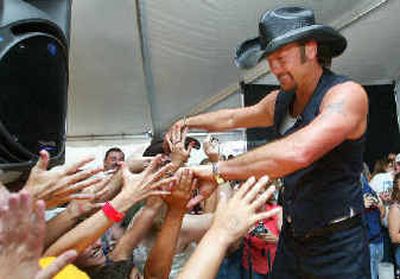
The din of guitars and drums echoes from a sound check while stagehands mill around and a helicopter whips the treetops.
“I guarantee that’s Big & Rich,” says country singer Tim McGraw, turning to see his opening act buzzing the Nashville, Tenn., amphitheater in a helicopter.
McGraw, 37, seems to enjoy the backstage commotion. He yells to friends, stops for interviews, poses for pictures and smiles a lot.
Tim McGraw is delighted to be, well, Tim McGraw. Ten years after his breakthrough, he remains a consistent hitmaker in an inconsistent, fickle business.
He’s had the biggest hit of his career this summer with “Live Like You Were Dying,” which spent eight weeks at No. 1 on the country singles chart. The album of the same name debuted at No. 1 this week on both Billboard’s country and pop charts.
There’s also a 63-city tour, a role opposite Billy Bob Thornton in the upcoming movie “Friday Night Lights,” and a high-profile marriage to fellow superstar Faith Hill.
But “Live Like You Were Dying,” about living life to its fullest, is special to McGraw for reasons far beyond its commercial success. He lost his father, former Mets and Phillies relief pitcher Tug McGraw, to cancer in January.
The lyrics tell of a man in his early 40s who learned he doesn’t have long to live and is asked how he handled the news:
“My dad was sick when I heard the song, and that definitely had a big influence on me,” McGraw says. “I knew instantly it was going to be my first single.
Since becoming a star with the novelty hit “Indian Outlaw” in 1994, McGraw has recorded 23 No. 1 hits, including “Where the Green Grass Grows,” “Angry All the Time” and “Real Good Man.” All told, he’s sold 30 million records.
At its best, McGraw’s music incorporates elements of pop, rock and R&B. And while he’s certainly a good singer, he’s not a great one. Many say his real talent is his ability to hear a hit, much like one of his musical heroes, George Strait.
“It’s a combination of two things,” said Tonya Campos, music director at Los Angeles country station KZLA. “The guy is loaded with sex appeal, and he knows how to pick a song.
Born in Delhi, La., he grew up as Tim Smith. But at age 12, he learned that his father was baseball pitcher McGraw, who had had a brief affair with his mother.
His mom and stepdad divorced when he was in the fourth grade, leaving her to raise him and his two sisters.
“She worked two or three jobs at a time,” he recalled. “I can remember being 11, 12, 13 years old and getting up at 12 o’clock at night and my mom sitting at the kitchen table with the bills spread out everywhere and not even knowing I was there with her head down crying. And then the next day the VCR being gone. It’s stuff you grow up with, but you learn a lot from that.”
McGraw went to Northeastern Louisiana University on a baseball scholarship and started singing and playing guitar. He dropped out in 1989 and moved to Nashville.
His break was meeting producer Byron Gallimore, who attended a showcase that netted McGraw a recording contract with Curb. His second album, “Not a Moment Too Soon,” yielded four hits including “Indian Outlaw” and “Don’t Take the Girl.”
McGraw and Hill were married in 1996 and have three daughters. Balancing two busy careers and a family isn’t as tough as it looks, he says.
“My kids and my family are my No. 1 priority,” McGraw says. “There’s not even a close second. So we make sure everything is right with that and then work down from there.”