
Get a fair shot at fair games
Strolling down the midway at California’s Orange County Fair last month, Bob Singh stopped at a $3 squirt-gun game and rolled up his sleeves. “I don’t normally do this,” he says, “but my niece would love that giant purple fish.”
Twenty minutes and six tries later, Singh had only scored enough to win a pathetic little rag doll. “I’d love to know the secret to this thing,” said the 43-year-old telecommunications executive.
It’s high season for America’s fair industry, with more than 200 state and county events under way this month, including today’s start of the Spokane Interstate Fair.
At least 43 million people are expected to turn out this year – attendance at some U.S. fairs is already up 10 percent to 15 percent, after a slow 2003 season – with big venues such as the Minnesota State Fair counting on $2.5 million in game revenue alone.
Even in the age of the Xbox, old-fashioned carnival games such as the shooting gallery are still luring customers – operators estimate fairgoers will spend upwards of $60.million trying to win prizes this summer – and sending most of them away fuming.
But it turns out there are ways to get an edge. Weekend Journal went behind the counter at some popular fair and amusement games and learned secrets, from how to aim your dart to the best time of day to play Roll-A-Ball.
One hint: At Singh’s squirt-gun game, where contestants fire at a target to inflate and burst a balloon, he should have observed a few rounds before picking his spot. That’s because balloons that have been repeatedly inflated and deflated without breaking are more likely to burst than a new one.
At many fairs, operators are devising new strategies to counteract player frustration while boosting profits. The biggest shift is toward group games pitting fairgoers against each other.
One popular example is Roll-A-Ball, essentially a lazy person’s version of Skee-Ball. Up to 15 players at a time sit on stools and roll ping-pong balls up lanes in a timed race, trying to reach holes marked 10, 20 or 30. Whoever accumulates the most points in the allotted time wins. (Tip: It’s better to play when things are busy to scope out whether a certain lane seems to be winning more often.)
There’s a reason operators like these group games. From a marketing standpoint, they counteract the house-always-wins image of carnival games, making possible a new pitch increasingly heard on the midway: “A winner every time.”
Group games add a new competitive element that prompts people to keep playing – they want to show they’re better than the guy next to them (especially if it’s a 10-year-old kid), not just snag the first prize they can.
Meanwhile, attention-getting flashing lights and sirens create the illusion that prizes are constantly being given away. But any individual’s chances of winning usually aren’t any better than with the old single-player games.
Winner-every-time games generally start out awarding a toy that costs about 30 cents wholesale and allow players to trade up to “super jumbo” animals that cost about $33.
At Six Flags Great Adventure in Jackson, N.J., one of the new group games is What’s On Tap, where players sit with a joystick that controls the movement of a pitcher. The goal is to keep the pitcher under a moving “beer” tap spouting water; whoever fills his pitcher first wins. The booth charges $3 a player, with a maximum of nine people playing at once.
In the course of a relatively slow hour on a recent weekday evening, the What’s On Tap booth brought in 88 people who played 20 rounds. The booth awarded 20 prizes, mostly throw pillows with sports logos on them, which fair suppliers say generally cost no more than $5.
In all, that translated to $264 in revenue, minus about $100 in prize expenses, for a gross profit of about $164. The booth is usually open about 12 hours a day in the summer.
On a busy weekend, booths like What’s On Tap can earn roughly $5,000 a day, operators say.
To help bring in as many customers as possible, they still employ old-fashioned carnival barkers to shout things such as “You’ve got to get in to win” or “Win one for the lady!” Barkers are aggressive for a reason: They work on commission, usually taking in 20 percent of what customers spend during their shift.
Below, some tips on how to beat some popular games:
Basketball
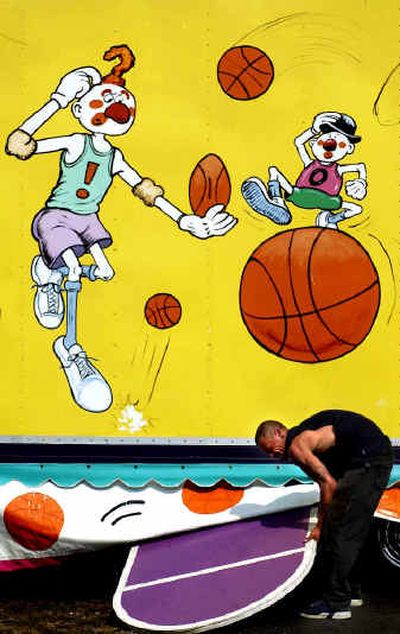
Inside scoop: A sign says the hoop isn’t “regulation.” Neither is the one in the driveway, right? But these hoops are sometimes pounded into discreet ovals, current and former operators say, and the balls are so overinflated they catapult off the backboard.
Secret: Don’t use the backboard and avoid the rim. Shoot in a high arch with the goal of dropping the ball straight into the hoop.
Prize size: Extra large. (Generally more than 36 inches tall and costs the operator about $11.)
Darts
Inside scoop: Flaccid balloons and dull darts make it hard to pop anything. Quite common since it’s so easy and cheap to build.
Secret: Ask the operator to use his personal set of darts. Most people aim at the middle of the board because there’s a greater chance to hit something, but the balloons around the outside tend to hide bigger prizes.
Prize size: Small, often a mirror etched with the image of a pop star (Britney Spears is popular). “People like to come away with something, even if it’s small,” says Tony Fiori, director of marketing for Arizona-based Ray Cammack Shows, one of the biggest U.S. carnivals.
Shoot Out the Star
Inside scoop: The goal sounds easy: use a BB gun to shoot the red star out of the center of a white piece of paper. But you only get 200 pellets, warns Brian Richardson, author of “Secrets of Amusement Park Games,” and the gun sights can be off kilter.
Secret: Fire a fast burst of pellets to see if the gun is firing straight and then correct your aim as needed. Don’t try blasting out the star’s center; instead, carve a circle around it. This is one game where operators have the power to declare a winner based on their judgment.
Prize size: One of the hardest games on the midway, it’s usually stocked with the biggest stuffed animals.
Basket Toss
Inside scoop: The baseball bounces right off the flexible bottom of the slightly tilted wooden peach baskets.
Secret: Toss the ball gingerly into the basket with a slight under spin – and lean over the counter as far as they’ll let you. The price is generally three balls for a dollar.
Prize size: Medium.
Dime Toss
Inside scoop: The sparkling tower of dishes and glasses is designed to make customers toss dimes sideways as if they were skipping rocks on a pond.
Secret: Those plates are slipperier than they look. As with basketball, toss the dime into the air in a high arch so it drops directly onto the dish.
Prize size: “Simpsons” collectible beer mugs, crystal cake platters.
Frog Launch
Inside scoop: This is a newer game where players use miniature catapults to toss rubber frogs onto rotating lily pads.
Secret: Most people mistakenly hit the catapult softly and aim for the closest lily pad.
Take the exact opposite action. Launch the frog as high into the air as possible without particular regard for the lily pads. The key is positioning the frog on the catapult with the legs folded under its stomach – as it might look in real life.
Prize size: Large stuffed animals. Usually – you guessed it – frogs.