
Challenge
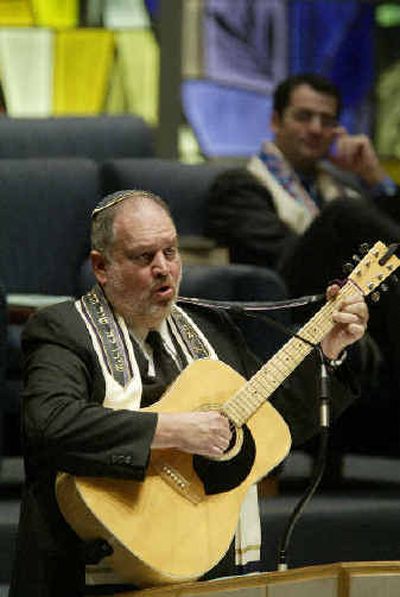
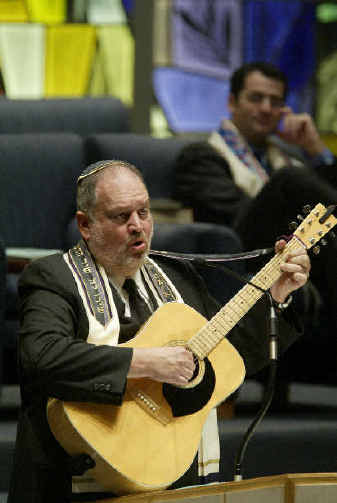
It’s an overwhelming annual challenge, both musically and spiritually.
For Jewish cantors, the High Holy Days are a tense time.
“It is, first of all, an awesome responsibility to be a messenger of prayer,” says one of the Reform branch’s most prominent cantors, Jay Frailich of University Synagogue in Los Angeles.
“It is the one time of the year you have everybody there. The singing load is quadruple any other time.”
Next Wednesday evening at the start of Rosh Hashana, the Jewish New Year, Frailich will be singing and chanting at two services, with morning and afternoon worship following the next day.
For Yom Kippur (the Day of Atonement) on Sept. 24, he’ll do another double in the evening, followed the next day by 10 a.m. and 1 and 3 p.m. services.
Yom Kippur is tougher than Rosh Hashana because the fasting regimen means no voice-soothing liquids may be consumed.
“The pressure is enormous,” says Scott Colbert, who administers the Atlanta-based organization for Reform cantors. “The cantor begins preparing several months prior to the holy days, preparing spiritually as well as musically.”
Colbert’s counterpart in the Conservative branch, Stephen Stein of Akron, Ohio, thinks other vocal performers often have an easier time of it.
Unlike a cantor, a soloist in opera or musical theater gets offstage breaks between scenes, Stein says. And if a cold or flu hits, he adds, understudies are ready to fill in “or if you’re a rock singer, you can cancel the concert. We can’t cancel the High Holy Days.”
Barbara Ostfeld, placement director for Colbert’s group and formerly a cantor in Buffalo, N.Y., says the emotional power of the holy days adds even more stress.
“You run your eyes over the congregation and you see much pain, much love, much loneliness and many tender moments, and it always did tend to choke me up,” she said. “You need to allow those feelings to be expressed in your singing, yet not be so moved by them that your singing is impaired.”
In 1975 Ostfeld became the first woman formally invested as a cantor. Women have outnumbered the men training to be cantors in the Conservative branch the past eight years, and among Reform Jews they’re fast nearing majority status. (Orthodoxy does not have female cantors.)
Their job description is broadening.
Today’s full-time cantors are expected to perform most tasks that rabbis do except preaching — and they occasionally do that as well. Most need to be increasingly adept with folk, pop and soft rock as well as the more florid traditional styles, and to play guitar or other instruments.
On the High Holy Days, however, many Jews insist on the comfort of the old familiar melodies.
“One could chant the Kol Nidre with a more modern tune — if one wanted to change jobs soon thereafter,” jests Henry Rosenblum, dean of the Conservative branch’s Cantorial School.
Frailich programs some contemporary music even on the holy days. For Rosh Hashana, his choir is performing a new setting of Exodus 25:8 (“Let them make me a sanctuary that I may dwell among them”) by Michael Isaacson and, at the Yom Kippur afternoon service, another Isaacson work memorializing the late film composers Elmer Bernstein, Jerry Goldsmith and David Raksin.
Today’s congregants want to “pray with music that is accessible, both intellectually and emotionally,” he says, “and I would put an emphasis on the emotional.”