
Going green
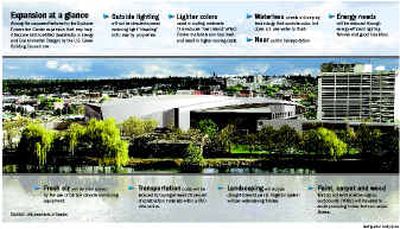
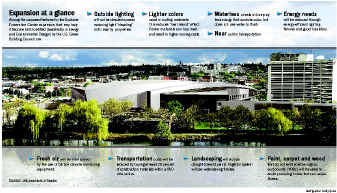
It’s not easy being green. Just ask developers of the Spokane Convention Center. Joining a trend that’s growing both locally and nationally, the Convention Center expansion team has set a goal of certifying the new 100,000-square-foot exhibit hall as an official “green building” when it’s complete.
That stamp would come from the nonprofit U.S. Green Building Council, which has created something called LEED (Leadership in Energy and Environmental Design) certification. It basically identifies a building as having been built with a high degree of environmental sustainability.
“Ultimately, this is driven by (the fact that) we want to create a healthy environment,” said Kevin Twohig, executive director of the Spokane Public Facilities District, which is overseeing the Convention Center expansion. “We want to improve the ground we’re going onto. We want to create a building that is built out of materials that are as sustainable as possible.”
Since the LEED program began in 2000, more than 180 million square feet of commercial building projects nationwide — about 4 percent of the industry — have been registered or certified as green building projects. Membership in the Green Building Council has jumped from 300 building-industry companies in 2000 to 4,800 today.
And though only one convention center, a 1.5-million-square-foot behemoth in Pittsburgh, has achieved LEED certification, more than two dozen others across the country have joined Spokane by registering their projects.
Industry experts say green building is catching on among the people who select sites for conventions, which result in millions of dollars in economic impact for communities.
“It’s a competitive advantage. If you’re looking at three centers and everything else is equal and your group is concerned about the environment, that puts you over the top,” said Mary Power, president of the Convention Industry Council, an umbrella organization of associations worldwide involved in the meeting, exhibition and convention industry. “We’re seeing more and more planners where it’s on their checklist.”
Though green building is not new in Spokane, the convention center would be the first LEED-certified project, if approved. Spokane School District 81, Avista Corp., Community Colleges of Spokane and Washington State University are among those building green projects or promoting green building practices locally. A coalition of local building professionals, the Resource Efficient Building and Remodeling Council (REBAR) also recently landed a state grant to train people in the construction industry on how to build green.
Holistic approach
Green building is more than putting in high-efficiency furnaces or lighting fixtures. It’s a holistic approach to construction that considers factors such as whether a building’s orientation takes advantage of natural lighting, whether construction materials can be purchased regionally to eliminate long-distance shipping and packaging, whether water can be preserved by landscaping with drought-hardy plants, or whether renewable energy sources, such as wind power, can be used.
Green building places a focus on the health and performance of the building’s employees and occupants as well. That dictates installation of carbon dioxide monitoring systems and elimination of construction materials that emit volatile organic compounds (VOCs), which can cause headaches and illnesses.
Statistics cited by the Green Building Council say the nation’s buildings — both commercial buildings and big apartment complexes — account for 36 percent of total energy usage and 65 percent of electricity consumption. They result in 30 percent of our greenhouse gas emissions and account for 30 percent of raw material usage.
Nationwide, 126 buildings have been LEED-certified. They include a community center in Buffalo, N.Y., a bottling plant in Michigan, a Bonneville Power Administration building in Vancouver, Wash., a hospital in Boulder, Colo., and a high school in Clackamas, Ore.
Savings over time
Upfront costs are generally higher in green building projects, largely due to the additional engineering and consulting required. The Green Building Council estimates such practices add up to 7 percent to the cost of a project.
However, Peter Locke, a Seattle architect working on the Convention Center expansion, said green building practices won’t add much to construction costs. “It’s just smart selection of materials and good engineering practices,” said Locke, who is certified to guide LEED projects.
What will cost more are the engineering, consulting and documentation required to certify the building under the LEED program. Registering a project with LEED costs 1 cent per square foot. Once the project is complete, certifying it as a LEED building costs an additional 2 cents per square foot, said Taryn Holowka, communications coordinator for the Green Building Council.
Twohig estimated that using green building practices and attaining LEED certification could add a total of $250,000 to the cost of the Convention Center project.
However, green building experts say those costs are easily earned back in the money saved on utility bills. A 2003 study in California showed that though initial costs of green projects were about 2 percent higher, that money was earned back through utility bill savings within six years.
“From there on out, you’re saving money,” said Jim Wavada, the state Department of Ecology’s sustainable building specialist and executive director of the REBAR council. “It costs 20 percent less to operate a green building. Those energy-saving numbers are pretty convincing for most people.”
Avista Corp. also is doing what it can to support the Convention Center project in becoming a green building. Avista already planned to provide the project with $200,000 in rebates for installing energy efficient systems. However, the project’s registration with the LEED program has driven Avista to develop enhancements for projects that become LEED-certified. The rebate programs are available to any customer that follows the same guidelines.
If the Convention Center expansion becomes LEED certified, Avista will provide additional rebates equal to $1.25 per square foot. That would add up to between $125,000 and $150,000, said Mike Littrel, an energy efficiency engineer for Avista.
“It’s going to cost a little more money today, but over the 20- or 30-year life of the building, that building will pay for itself in reduced energy costs, reduced operations and maintenance costs and better indoor air quality,” Littrel said. “I think it’s going to be a high-profile enough project that it will really start to move the market.”
Green schools
Other projects around the region also are helping green building to catch on and grow. In its construction and renovation of schools, the Spokane School District has committed to abide by new sustainability standards being developed by Washington state. The new Lincoln Heights Elementary School, scheduled to be constructed during the 2005-2006 school year, will be one of five pilot projects built to the new standards statewide, said Mark Anderson, associate superintendent for school support services.
Over the next six years, the school district will spend $170 million of voter-approved money to build three new elementary schools and renovate two high schools, Anderson said. After the bond passed in March 2003 that approved the funding, the district held a two-day community conference to determine what design standards should be followed in district building projects. Among the desires expressed were that the buildings be environmentally friendly and long-lasting, Anderson said.
“We’re incorporating green building design standards into all of our projects,” he said. That includes building the new elementary schools out of brick, for durability and to eliminate the need for paint. It includes energy systems that bring in fresh air and can heat or cool specific to each room. And it includes orienting each building in such a way that it takes advantage of daylight. Studies have shown a 25 percent gain in student learning in buildings lit largely by daylight, Anderson said.
“It’s probably going to cost a little more to build, but in the long run, you’re going to save on your operational costs,” Anderson said. “You’re not going to pay as much for gas and utilities. My hunch is it evens itself out over the years. And in the meantime, it’s much more comfortable for the users and much less damaging to the environment.”