
Bridge
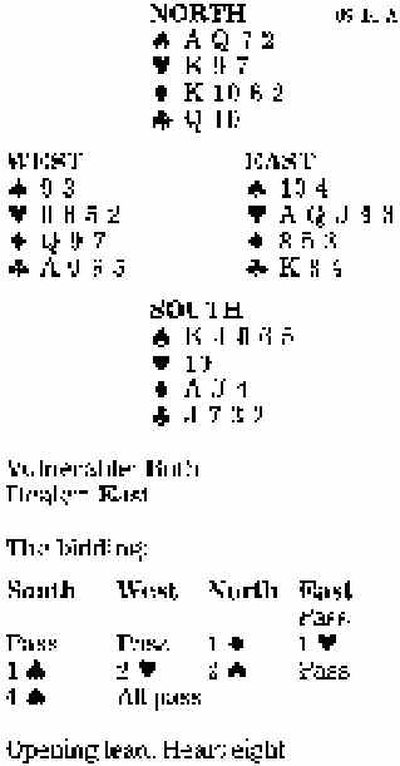
Do not forget the auction — and especially the inferences, positive or otherwise, arising from it. For example, when North opens in fourth seat and freely raises the one-spade response to two spades, he suggests four-card trump support. South could make a game-try with three clubs, but he could just as sensibly make the simple jump to the spade game, hoping to find at least reasonable play for his contract.
When you hold three or four small cards in partner’s suit, it is a good idea to lead low if you have not supported him, but to lead the top card if you have raised him. Accordingly, West leads the heart eight. East wins the opening lead and shifts to a trump.
South knocks out the club ace, ruffs the heart return, draws a second trump, ruffs the last heart, and drives out the club king. On lead, East plays a third club. South takes the jack, ruffs his last club in dummy and pauses for reflection. Who has the diamond queen?
This is not a tough one if you think about it correctly. East has shown up with the club king and seven points in hearts. He cannot hold the diamond queen, or he would have opened the bidding — so West has the missing queen. If you remember the bidding, you will often find that the negative inferences that can be drawn are as helpful as the positive ones.
Bid with the aces
South holds:
| •K J 8 6 5 | |
| •10 | |
| •A J 4 | |
| •J 7 3 2 |
| South | West | North | East |
| 1 • | 1 • | ||
| 1 • | 4 • | Pass | Pass |
| ? |
Answer: Double, a call that simply shows cards and is optional, rather than being 100 percent for penalties. It would be premature to rebid spades or to support clubs — after all, partner could have only a three-card club suit. Better to show values and let partner remove the double if he is really suitable for spades.