
Geese police empty parks
BELLEVUE, Wash. — The Canada geese are mostly gone from at least three city parks ringing Lake Washington, taking with them the poop that for years made a trip to the beach an unpleasant outing.
They’ve flown elsewhere, scared off, then kept at bay by dogs trained to herd sheep. Years ago, some of the geese were shipped east of the Cascades.
The eggs of others were made infertile by a coating of oil, a procedure called addling.
All those efforts have reduced the Canada geese population around the lake, according to parks officials. Of course, if those geese who remain aren’t in the parks, they are somewhere, including farther inland.
But officials haven’t received any complaints from neighbors.
“They understand that geese are going to move around,” said Jim Nissley, parks resource manager for the Bellevue Parks Department.
So it’s hard to blame the geese for the high levels of bacteria that closed Lake Washington to swimming at Gene Coulon Memorial Beach Park in Renton recently.
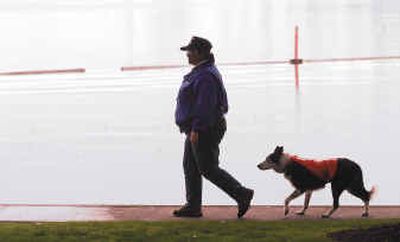
Perhaps the greatest threat to the geese came when Lynn Kalnoski and her dogs hit the beaches about five years ago. Kalnoski of Stanwood, owner of Kalcade Geese Police, patrols beaches daily in Renton and Bellevue and less frequently at Juanita Beach Park in Kirkland.
The improvement is most noticeable at Gene Coulon Park, where at one time up to 300 geese a day lounged on the grass and in the water. They destroyed large tracts of grass the city had to replace.
Her success extends to Meydenbauer Beach Park and Newcastle Beach Park in Bellevue. Newcastle Beach is still a draw this time of year when the geese are scooping up small apples that fall from trees there.
“Oink, oink,” Kalnoski quips.
That’s typical of the seasonal ebb and flow of her work. This winter, she’ll turn her attention to Downtown Park in Bellevue, where widgeons swarm over the lawn like locusts, damaging the grass.
At Gene Coulon Park, coots are a problem in winter, but their numbers also have dropped.
She’s not in danger of losing her job.
“I am not doing a good job if I don’t run into that possibility,” she said. But experience shows that the geese would return within a month or so if Kalnoski and her dogs weren’t around.
Bellevue pays her $36,000 for her nearly year-round work. Nissley said the city is very satisfied with her work.
“I think if we stopped using them, we would be back in trouble again,” he said. “As long as there are geese, we will have this challenge.”
Kalnoski says she’s now managing the goose population at the parks.
Kalnoski’s tactics have been more effective than placing a material on the grass the geese find distasteful or colorful cones the geese soon learned weren’t predators, Nissley said.
Up to 150 geese have returned to Newcastle Beach Park after her services ended in September. Nissley doesn’t know if the geese have read her contract, he jokes, but “they certainly know when the active presence isn’t there and they actively repopulate.”
Kalnoski is paid about $50,000 a year for her daily forays to Renton’s Gene Coulon Park. She hasn’t had a vacation in five years and personal time on the weekends is at a premium.
Renton parks director Leslie Betlach said the goose problem hasn’t been solved, but their numbers have been reduced significantly.
On a cool rainy Thursday morning, the wildest things on the Gene Coulon Park beach were a young rabbit, squirrels, crows, seagulls and a bunch of ducks who had the swimming beach all to themselves.
But no geese. It has been that way for a long time.
Kalnoski is lucky if she finds even a handful of geese at the park. She varies the time when she’ll visit the parks, to keep the geese off-balance.
Kalnoski is able to control her dogs with signals from her whistle or with her voice. She can stop them dead, send them into the water and bring them back to her.
Fishermen and walkers under umbrellas stop to watch the show.
On her command, Troy, a smooth-coated border collie, jumps into the relatively warm lake without hesitation. She can even command him to urinate.
The same techniques have been used for centuries by border collies and their handlers to herd sheep.
Their working relationship is also what sets them apart from other dog owners who let their pets run uncontrolled at parks. (Dogs aren’t allowed at Gene Coulon Park.)
Kalnoski’s border collies succeed because they stalk or herd the geese like predators. The geese recognize the danger. But the geese realize dogs that simply chase them pose no real danger and soon ignore them, she said.
But she also warns that dogs that simply chase geese eventually could become marauders who might kill or maim a goose or other wildfowl, in violation of federal laws.
Kalnoski approaches her job with wit and humor and an obvious love for her crew.
It’s a compliment to her when someone says, “Your life has gone to the dogs.”