
They’re the roast of the town
PONDERAY, Idaho – Farmers sink years into growing choice coffee beans. Roasters get approximately 15 minutes to execute their craft.
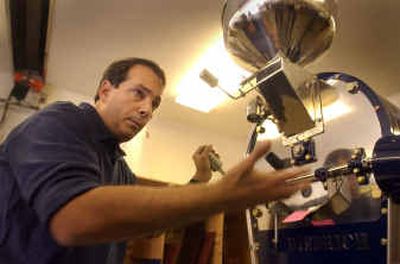
Whether the bean is an evenly roasted specimen, full of flavor, or a half-charred, half-green reject, depends on the skill of the coffee roaster – and the machine itself, of course.
“You’ve got a very narrow window of time to separate out the subtle nuances that bring out the different roasts,” said Philip Meech, a wholesale coffee roaster who owns Caffe Luso in Redmond, Wash. “It requires a surgical-like precision.”
That’s why Meech is fussy about his machines. He’s a particular fan of coffee roasters made by Diedrich Manufacturing of Ponderay, Idaho.
“They’re like a Mercedes. They’re just as well built,” contends Meech, who expects to spend $200,000 on his next Diedrich roaster.
Diedrich Manufacturing builds 14 models of high-end coffee roasters, ranging in price from $7,500 to $500,000. During its 24 years in operation, the firm has developed an international following.
Each day, the sales department handles calls from up to five international time zones. About 2,000 of Diedrich’s gas-powered roasters are in operation worldwide, at locations ranging from Spokane to Singapore.
Michael Whitley, Diedrich’s director of sales and marketing, credits word-of-mouth endorsements like Meech’s.
“It’s a very friendly industry, and people talk,” he said.
Diedrich Manufacturing’s association with coffee dates back three generations.
Founder Steve Diedrich grew up on a coffee plantation in the Antigua region of Guatemala. In the 1970s, his family moved to California and opened a coffee house in Newport Beach. Diedrich, an engineer by training, began building coffee roasters in 1980.
“He literally grew the company roaster by roaster, flying around the world and showing them at trade shows,” Whitley said.
In 1993, the company moved to North Idaho. Diedrich remains active in the firm, though he’s currently undergoing treatment for cancer.
At the company’s manufacturing plant, workers put the finishing touches on a roaster headed to a Costco warehouse this week. The Issaquah, Wash.,-based chain is one of the company’s regular accounts. A Diedrich roaster produces the coffee that sells under Costco’s Seattle Mountain brand.
The largest Diedrich model can toast more than 500 pounds of coffee beans at one time; the smallest, one to seven pounds.
A Starbucks-like smell wafts through the 13,000-square-foot plant. “Test roasts” are part of quality assurance.
All of the roasters’ components are made in Ponderay, said Tim Frazier, operations manager. That’s more expensive than importing parts from China and assembling them, but the finished product is better quality, he said.
The concept of a coffee roaster is relatively simple. Green coffee beans are poured into the roaster; a drum turns them so they roast evenly. When the roast is complete, the beans are quickly cooled, so they don’t burn or over-bake.
To master roasters, however, there’s much, much more to the process, Whitley said. They talk about “carmelization,” “acidity,” “air flow dynamics,” and “first crack” – the temperature at which the bean expands. Roasting is a complex chemical process, and a green coffee bean is “a highly sensitive, biological item,” he said. In addition to manufacturing roasters, Diedrich holds seminars to train people how to create different flavors, he said.
Diedrich Manufacturing projects sales of $5 million this year. The company has added 10 employees since January, bringing the current total to 51. The firm is in a period of “measured growth” amidst explosive expansion in the industry, Whitley said.
Specialty coffees represents just 10 percent of overall world coffee consumption, but the market is growing by 25 to 30 percent each year. Even Seattle, the birthplace of American specialty coffee, hasn’t experienced market saturation, Whitley said: “We almost always have a roaster in production for Seattle.”
The Midwest represents one of the fastest-growing U.S. markets for specialty coffees, he said. Overseas, the brews have made large inroads in the tea-drinking regions of Asia. Japanese clients are a large customer base for Diedrich Manufacturing, and China represents a huge potential market. “We just got an order from India,” Whitley said.
Along with market growth, the company is also developing new products. One of its latest is an automated machine that will duplicate different roast profiles. It’s like following a recipe, so you get the same quality and consistency every time, Whitley said.
Diedrich Manufacturing’s challenge is to not grow too quickly, he said.
Meech, the Redmond coffee roaster, agrees. He likes being able to call and get Steve Diedrich or other top managers on the phone.
“Steve wants our customers to feel like they’re doing business with a small, family-run company,” Whitley said.