
Hampton gets his groove on
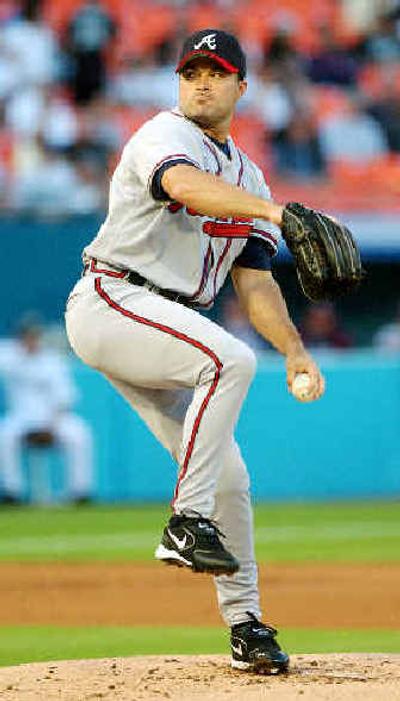
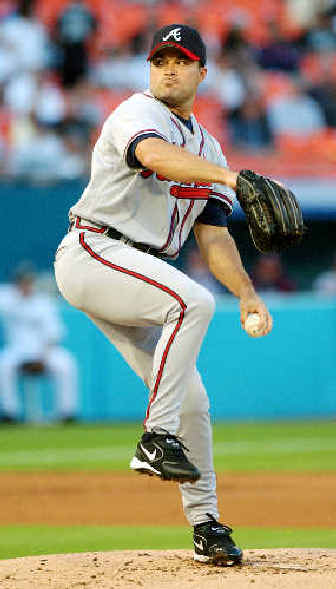
PHILADELPHIA – Throughout the off-season, baseball fans heard that the Atlanta Braves were still the team to beat in the National League East because they had two aces in John Smoltz and Tim Hudson.
Don’t buy it. The Braves actually have three aces.
In case you haven’t noticed, Mike Hampton is back – and just in time to face the Phillies tonight at Citizens Bank Park.
Hampton has gone six and eight innings, respectively, in his first two starts, allowing just a run in each. He did not walk a batter in his last outing, Monday against Washington.
But two good starts hardly indicate that Hampton has returned to the form that made him a 22-game winner for Houston in 1999.
To see how far the 32-year-old lefty has come from his disastrous (but profitable) two-year hitch in Colorado, you have to go back to the beginning of July.
Since then, he is 12-1 in 16 starts.
“Run support,” Hampton said, deflecting attention from himself.
Well, there’s been more to Hampton’s run of success than run support.
His ERA over that 16-start span is 2.78. He has allowed one run or less in nine of those starts.
This is the Hampton the N.L. remembered, the Hampton who was barely 28 when he won his 85th game, the Hampton who never gave in to a hitter.
It all changed for Hampton after the 2000 season when he was lured to Colorado by an eight-year, $121 million contract, the largest for a pitcher. The Rockies believed Hampton’s sinkerball would be a perfect fit in the pinball machine that is Coors Field. Hampton believed he could thrive there, too.
Everyone was wrong.
In two seasons with the Rockies, Hampton went 21-28 with a 5.75 ERA. He had the worst ERA among qualifying N.L. pitchers in 2001 (5.41) and 2002 (6.15).
“Ah, that wasn’t anything more than Coors Field,” said Braves pitching coach Leo Mazzone, who always believed Hampton would rebound.
Coors Field sapped Hampton of his confidence and trademark competitiveness. The effects were even felt away from Denver as his ERA was higher on the road (5.77 to 5.73) in two seasons with the Rockies.
“Denver is the toughest place to pitch in the majors, but I didn’t hold up my end of the bargain, either,” Hampton said. “It was just so mental. I got away from thinking I had to make good pitches to get guys out and started thinking I had to make great pitches to get guys out. That’s no way to pitch. You’re very vulnerable to getting beaten up when you do that. I was pitching defensively and you get killed if you do that.
“Now, I’m challenging hitters again. I didn’t do that in Denver. I was 2-0, 3-1 on everyone because I was trying too hard to be perfect.”
The Rockies recognized the problem and moved $84.5 million of Hampton’s contract, with the Marlins and Braves picking up part of it in a three-way deal.
Hampton ended up closer to sea level with Atlanta in 2003. The deal called for the Braves to pay him just $5.5 million from 2003 through 2005. But things looked a little risky at the back end, where the Braves were responsible for $43 million from 2006 through 2008.
If Hampton keeps pitching the way he has since the beginning of July, that will be money well spent.
Had Hampton signed with Atlanta instead of Colorado in December 2000, his impressive career may never have suffered such an ignominious detour.
But Hampton does not regret signing with the Rockies.
“I felt it was a place I could win,” he said. “I’m a ground-ball pitcher. If anyone is going to be successful there, it was someone like me. It just didn’t work out.”
Other than $121 million, something good might have come out of Denver for Hampton.
“In Houston, I never experienced failure,” he said. “I never knew how to look at it or deal with it. Once you face failure, I think you become better. I’m a little smarter pitcher now. I didn’t savor wins like I should have. Now when I win a game, I’m thankful for it more so than I was in the past. The key to flushing (the Denver effect) is success.”