
play time
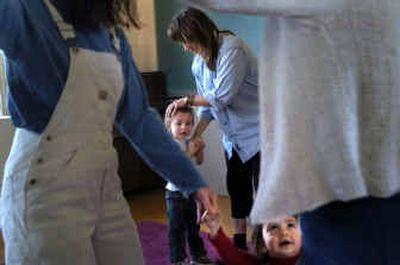

toddlers – some just over a year old – sit in a circle on the floor. They laugh, clap and sing. Sometimes they stand and jump to the rhythm of a steady beat. Sometimes they wave colorful bandanas or stomp their feet.
If you think this looks like a typical day-care scene, think again.
It’s a music lesson.
Even the youngest among us can be musically trained. A few of those toddlers will begin private lessons on piano or violin before they’re five. Others may wait until elementary school or even later.
So, when is the right time to start music lessons? Parents, whether or not they themselves are musical, often struggle with the question. Answers differ, but local experts agree on one thing: the right environment for young children can foster a lifelong appreciation for music.
Pam Davies teaches that toddler class at Holy Names Music Center in northwest Spokane. All parents can encourage children in music, she says. “It helps greatly if the child’s environment is musically rich – in the car, at home, going to live performances. And I believe any child can develop musically if given the right circumstances.”
Linda Honn, an elementary music teacher in the Central Valley School District, agrees on the importance of a musical environment. “Parents can sing or find videos and CDs. They can play classical and children’s songs.”
In fact, the type of music is not as important as how it’s used. Davies recommends a variety of musical styles – “classical, rock, country – anything with a melody and rhythm. If children see their parents enjoy music, they will be drawn to music, even if the parents don’t actually play an instrument.”
Professional musicians often look back on their childhood experiences and recognize a pattern of music appreciation through their parents. Eckart Preu, Music Director of the Spokane Symphony, is a good example. Drawing from his earliest memories, he recalls, “There was always music in our house. The whole family was involved.” Likewise, the Symphony’s bass trombonist, Brian Honsberger, remembers attending concerts and chamber music performances when he was very young. “My parents helped me focus and pay attention to the music,” he says.
Still, there comes a moment when parents must decide on private lessons. What factors should they consider? Davies, besides leading music classes at Holy Names, teaches private piano to preschoolers three to five years old. She watches for certain characteristics before allowing a child to take lessons. “Sometimes I see a particular student who has a good level of concentration,” she says. “I also look for a level of interest and self-motivation.”
Like Davies, Linda Honn emphasizes that children must be motivated within themselves. Her advice to parents: “Do not force! The kids learn to hate it if the parents force them to take the lessons.”
She teaches private piano but generally will not accept a child who hasn’t completed at least half of first grade. “I look at reading ability,” she points out. “That’s important because it’s left-to-right,” the same as reading music. She also considers eye-hand coordination and small motor dexterity in fingers.
The choice of instrument and the physical development of the child play a part as well. Honsberger teaches private trombone, euphonium and tuba lessons. He usually doesn’t accept a student before middle-school, because most younger children are too small to handle the instrument comfortably.
While all these factors are important, experts generally come back to motivation as their primary consideration. Dr. Amari Pepper Barash is Assistant Professor of Music, Coordinator of Music Education, and Coordinator of Graduate Studies in Music at Washington State University. “Rather than deciding to accept a student based on age, I usually ask to meet him or her first for a short trial lesson,” she says. “I try to make sure that taking lessons is the child’s own idea. To me, this is the key piece of information.”
For preschoolers who have this self-motivation, parents may notice certain advantages in enrolling them in music training. First, says Barash, they “generally seem more open to new ideas, and there are limitless ways to provide exciting and stimulating musical lessons for them. They are not embarrassed to sing, to dance, to move with the music. This can be very advantageous for development of a sense of pulse and rhythm, and can foster a comfort with and love of music that is important later on in life.”
Developing a discerning ear for sound is also a vital part of music education, says trombonist Honsberger—and the earlier the better. “My sister started taking piano lessons really early. She always could hear things better than I could. That’s the advantage of starting younger.”
However, music teachers see disadvantages as well. Barash points out that “young children can become frustrated or bored with their practicing.”
Preu was a typical example. “I started on piano at age five, and my teacher made it fun,” he remembers, “but I never enjoyed practicing – never ever! I had lots of trouble with that until I was 10, 11 or 12.”
A similar problem might become apparent shortly after lessons have begun. “Some young children may show an interest for a time as a novelty, but later lose interest,” says Davies. They may become frustrated, and this in turn frustrates parents, who must decide whether to continue the lessons. If they continue, parents may find themselves in the role of enforcer. Preu says, “My father just insisted, and my mother bribed me.”
Yet, parents can find other ways to encourage their preschool children to continue in music. Jim Probasco, author of “A Parent’s Guide to Teaching Music,” recommends that parents attend lessons with their children. He says parental involvement is an important key to learning. Davies agrees, noting that “parents must understand what the child is working on so the parent can guide him at home. A lot of the teaching will fall on the parent. Non-musical parents can do this, as long as they’re willing to take the time to understand.”
Going a step further, Preu suggests that parents take lessons and learn to play the instrument along with their children. This way, the child has a partner in the activity. Parents’ enthusiasm in their own progress will usually rub off on the children. However, Preu cautions that an adult’s learning curve is different from a child’s. Adults may learn much faster at first, but children will usually catch up and surpass their parents in a few months. “But,” he says, “if parents have that discipline – even ten minutes a day to work with their child – it’s good for social togetherness as well as for music.”
In spite of numerous studies on the advantages of starting very young children in formal music lessons, not all youngsters are ready by age five or six. But that doesn’t mean they’ll never be musical. Chandra Hein, who grew up in Spokane Valley, is now a junior music major at Samford University in Birmingham, Alabama. Surprisingly, she showed little interest in music until sixth grade. That’s when she signed up for flute in beginner band, and she later learned saxophone and trumpet at Central Valley High School. She’s now looking at graduate programs and plans to become a band director after getting her master’s degree in music. All this came about without a formal music education in her early years.
Likewise, Melissa Sessions of Liberty Lake didn’t start piano lessons until middle school. She lived in another city at that time, and her parents were at first discouraged when searching for a private instructor. “We heard from some teachers that Melissa was just too old,” says her mom, Loretta Sessions. “They’d say, ‘Well, we’ll try to teach her, but you know she’ll never have a real grasp of music. You’re starting her too late.’ “
But Sessions is pleased to report the opposite is true. Melissa, now 17, has exceeded expectations. She serves as assistant pianist at her church, and she plays regularly in recitals sponsored by her current teacher. “While she’ll probably not be a concert pianist, she plays well and with confidence,” says her father, Don Sessions. “We’re so happy that she loves music.”
No matter what age children start formal music training, parents have a vital role in encouraging their progress – before and after the lessons have begun. Barash reiterates: “I think that parents can set an example for their children by showing their own interest in music. Just as it is true with reading, sports, or any other activity, if the child sees the parent engaged in the activity, he or she is likely to take an interest in it as well. Parents who go to concerts and listen to music at home are likely to raise children who share those interests in music.”
When parents set this positive example, their youngsters will develop as musicians. Establishing music as a pleasant part of everyday life is always a wise choice. It eliminates many of the negatives which young children can experience in music. Says Honn, “It’s all about being able to succeed without frustration.”