
B.C. fishing to be more expensive
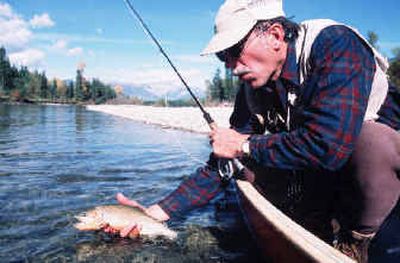
Anglers will pay a premium this year to fish seven of the most popular streams in southeastern British Columbia.
To help reduce pressure in the East Kootenay Region, a special $20-a-day permit (Canadian funds) will be required for out-of-province anglers who fish the Bull, Elk, Kootenay (upstream from White River), St. Mary, Skookumchuk, White and Wigwam rivers and their tributaries.
The new “classified waters” permit will be required in addition to the regular British Columbia fishing license. The special $20-per-day permit will be good only on the stream for which it is issued.
“There’s been classified waters in place in the province for years, starting with the high-quality steelhead rivers such as the Dean,” said Al Marden, British Columbia’s director of fisheries and recreation allocation. “Now the effort on some of the trout streams is becoming an issue.”
“The rivers have been overfished the last two years,” said Rod Zavaduk, owner of the Castlegar Sports Centre and Fly Shop. “They need a rest for the trout to recover.”
On some days last year, as many as 20 rafts, pontoons or boats were simultaneously working some long holes along the Elk.
The cutthroat suffered, said Kelly Laatsch, a fly-fishing guide based in Kimberley, noting that “they were forced to change their habits and many became unusually thin.”
The streams have become increasingly popular in the past decade after word spread about the good numbers of eager-biting cutthroats.
British Columbia residents also will have to buy a $20 permit to fish the classified streams, Zavaduk said, but their permits are for a year. Anyone who lives outside of British Columbia must pay $20 a day to fish the rivers.
“The Albertons are angry that they’ll have to pay $20 a day,” he said.
Laatsch, who represented guides in the negotiations with the provincial government, said quotas on the number of classified waters permits have been established for each angler group — residents, non-resident Canadian and non-resident alien. Once a quota for an angler group for a stream has been reached, he said, no more licenses will be issued for that group.
However, Marden, government director for the program, said a general user quota has not been enacted.
“Limits on non-residents were suggested, but we’re not there,” he said last week.
“The only quota will be on the number of angler days each guide can take out on the rivers.”
In other words, anglers planning to fish with a guide might want to book early to make sure his quota isn’t filled. But anglers traveling to Canada to fish on their own should be able to buy classified waters permits over the counter anytime, at least for this year.
Kelly acknowledged that the new rules are a work in progress and that changes will be made as fisheries biologists evaluate the program.
Laatsch also said the province tightened regulations for several popular fishing lakes in the Kootenay district, including Echo Lakes, Little Mitten, McLain, Nine Bay and Wilbur.
Effective this year, the daily limit is one trout 30cm (about 20 inches) long or longer a day. Bait is banned and a single hook required.
Until this year, Whitetail — popular with Americans — was the only lake in the Kootenay region that was managed as a trophy trout lake.
Even though anglers can’t kill more than one rainbow a day at Whitetail, the average size has dropped considerably the last few years, Laatsch said. Several other lakes, including Whiteswan, yield more large rainbows than Whitetail.
(Outdoors editor Rich Landers contributed to this story.)