
All the right moves
The typical Best of Broadway show is a big musical from the ‘40s or ‘50s filled with toe-tappin’ tunes and characters named Aunt Eller.
“Contact,” which opens tonight at the Spokane Opera House, is not one of those shows.
It promises to be bracingly different: a series of three self-contained stories about love, told almost entirely through dance.
A musical in which nobody sings? In which the music is all pre-recorded? With almost no dialogue?
Sounds like an unlikely hit. Yet it caused a sensation on Broadway in 2000 and went on to win the Tony Award for Best Musical.
Actually, the show ran the table. It was also named best musical by the Drama Desk, Outer Critics Circle and Drama League.
The reason: It’s the purest expression yet of the genius of director-choreographer Susan Stroman.
“Each move she created has a purpose,” said dancer Allie Meixner, by phone from a tour stop in California.
“There’s no dance move in the show that she created just for fun. It’s so detailed, and people who see it three or four times pick up on even more details.”
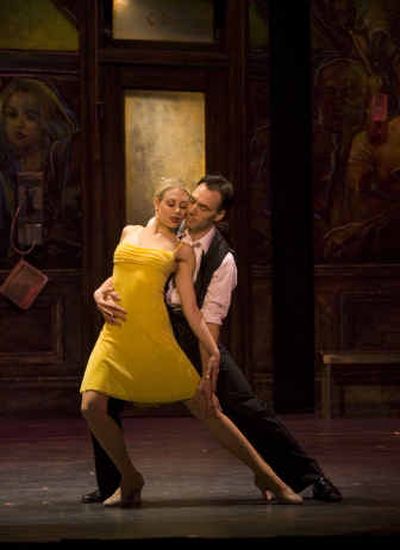
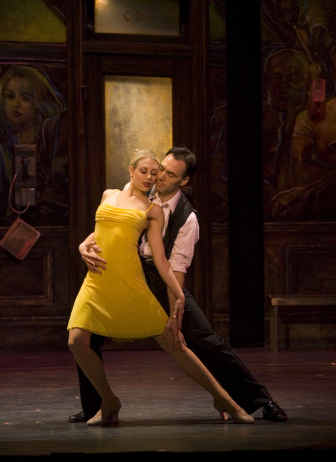
Meixner portrays the Girl in the Yellow Dress in this national touring company. That’s the show’s signature character, the one who was emblazoned across New York buses from 2000 to the show’s closing in 2002, and the one now emblazoned across Spokane billboards.
The Girl in the Yellow Dress is the lead dancer in the third and final story of the show.
“She’s the girl in the club who everyone wants but no one can have,” said Meixner.
One man in this New York dance club is particularly smitten. He’s a successful advertising executive who seems to have everything he wants. What he doesn’t have is contact with another human being.
The Girl in the Yellow Dress floats in and out his vision – a graceful and beautiful enigma. She becomes a fantasy figure in his mind.
This story is played out to the background of familiar pop tunes, including the Beach Boys’ “Do You Wanna Dance” and Dion’s “Runaround Sue.” This use of recorded music was controversial when “Contact” debuted on Broadway, yet it was an artistic decision on the part of Stroman.
“We believed the particular stories we were telling could be told most powerfully, effectively and theatrically against a backdrop of familiar recorded music,” said Stroman, in a press release.
In this story, the songs come from the man’s CD collection at home.
The other two stories are far different in approach. The middle scene, “Did You Move?,” takes place in an Italian restaurant in Queens in 1954. A downtrodden and abused wife fantasizes to music by Tchaikovsky, Grieg and Bizet.
The opening scene, “Swinging,” takes place in a forest glade in 1767 and features a woman on a swing, an aristocrat and a servant. It’s inspired by the famous 1768 French painting by Jean-Honore Fragonard.
“That scene is about sexual contact, but they are wearing 17th-century costumes, so they are completely covered up,” said Meixner.
The show has many sensual elements and may not be suitable for children. Meixner called it “PG-13.”
This non-Equity touring company has a cast of 24 dancers, including several “swings” – not to be confused with dancers on a swing. “Swings,” in theater parlance, refers to stand-ins, available to fill in for ill or injured performers.
This tour has done more than 100 performances in cities around the country, and Meixner said audiences react differently in every one.
“Some love it and some walk out wondering what just happened,” said Meixner. “But it’s not weird. It’s unique. It’s Stroman’s signature piece.”