
Wal-Mart wants bias case tossed
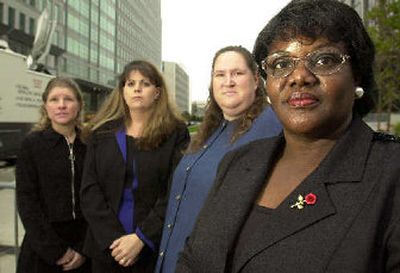
SAN FRANCISCO — Has Wal-Mart Stores Inc., the world’s largest private employer, grown too big for the U.S. justice system?
That provocative question is the key to Wal-Mart’s defense against a lawsuit filed on behalf of 1.6 million former and current women employees. Lawyers pursuing the class action claim Wal-Mart systematically denied raises and promotions to women and paid them less than their male counterparts.
Wal-Mart denies any pattern of discrimination and has appealed the decision of U.S. District Judge Martin Jenkins to proceed to trial, calling the case “gargantuan,” “elephantine” and “unprecedented,” among other things.
But what really bothers the Bentonville, Ark.-based retailing powerhouse is the judge’s compensation plan: If companywide gender discrimination is proven at trial, it could force Wal-Mart to pay billions of dollars to all women paid less than their male counterparts, with no opportunity to dispute their individual circumstances.
Jenkins rejected the idea of 1.6 million individual hearings in the nation’s largest civil rights case as “impractical on its face.”
Wal-Mart calls that an unprecedented denial of due process in its appeal, which seeks to have the entire case dismissed. The 9th U.S. Circuit Court of Appeals hears arguments on Aug. 8.
Lawyers for the women — including six current and former employees who are the named plaintiffs — say a statistical compensation formula that factors in seniority, pay, gender, job description and store location does follow precedent in class-action cases, and besides, it’s the only workable way to compensate such a huge class of victims.
“The fundamental purpose of federal class actions is, after all, to promote the efficient enforcement of federal rights where individual litigation is impracticable or too costly,” said Bill Lann Lee, a class-action lawyer who filed a friend-of-the-court brief on behalf of Consumers Union and other groups. His firm, Lief, Cabraser, Heimann & Bernstein, is one of the nation’s most prolific class-action filers.
Wal-Mart says the conventional rules of class actions should not apply in this case because its 3,400 stores, including Sam’s Club warehouse outlets, operate with so much autonomy that they are like independent businesses with different management styles that affect the way women are paid and promoted.
“The nature of the individualized claims, the scope of the class, their varying jobs, their location and the number of stores and the number of people in this class action, that makes this class unmanageable,” said Theodore Boutrous, Wal-Mart’s lead attorney in the case. “It’s unworkable: 3,400 different stores and 3,400 different managers.”
Boutrous has suggested that women who allege they were discriminated against file lawsuits against individual stores.
The women’s lawyers said the idea was ridiculous, and would clog the federal judiciary.
“What they’re saying is ‘we’re so big that you can’t possibly certify a class that challenges our practices,”’ said Joseph Sellers, one of the lead attorneys for the women.
Reflecting Wal-Mart’s uniquely powerful role in the American economy — the company earned $10 billion last fiscal year and currently employs 1.3 million people — the appeals court has received dozens of legal briefs from groups across the nation’s legal, political and economic spectrums, each predicting dire consequences.
Women’s rights groups and the Consumers Union argue that Wal-Mart’s assertion that it should individually try each woman’s case to determine compensation is simply a ploy to get the case dismissed.