
Bringing clothes up to code
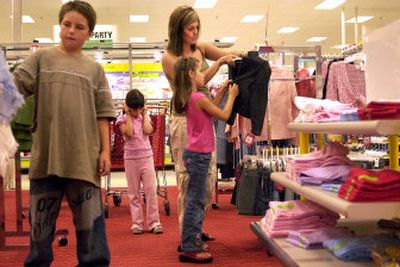
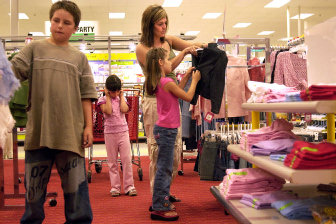
The Central Valley School District’s message is clear when it comes to school fashion this year.
Keep your underwear where it belongs, under your pants. As for cleavage, midriffs and bare backs, keep those under wraps, too.
The district adopted a new dress code over the summer to include more specific rules for each grade level.
“There wasn’t any consistency on how the dress code was applied in our buildings,” said Melanie Rose, district spokeswoman. “Having policies in place gives principals the ability to apply discipline. It’s clear what the rules are now.”
Faced with more sexually provocative clothing choices for girls, T-shirts emblazoned with lewd or vulgar language, and other clothing that schools consider distracting to the educational process, Central Valley joins districts nationwide that have re-evaluated dress code policies in recent years.
Since 2000, according to the U.S. Department of Education, 47 percent of public schools have enforced stricter dress codes.
“There’s free speech and First Amendment issues with regard to student expression, we know, and we don’t take those issues lightly,” said Jerry Thomas, a Central Valley administrator. “We believe in the Constitution, but we also believe that school is a lot like work. Kids go to school like adults go to work, and there is appropriate attire for those settings.”
Thomas was in charge of the committee made up of teachers, principals, parents and students that put together Central Valley’s new policy.
For middle school and high school students, “clothing that reveals undergarments, bare midriffs, bare backs, or cleavage is not acceptable school attire.” The same goes for clothing with references to alcohol, tobacco, drugs, violence, vulgarity and profanity. Skirts must be below the fingertips.
Middle school boys cannot wear hats. Flip-flops are inappropriate for elementary school students, for safety reasons.
While the rules were made clearer for Central Valley students, they are not new to Spokane area schools. Many use the same rules for governing dress.
“We just did a new dress code last year,” said Pauline Zambryski, an assistant principal at Spokane’s Shadle Park High School.
Spokane Public Schools does not have a districtwide dress code, leaving the rules up to individual schools.
“The challenge is that clearly kids are buying what’s out there,” Zambryski said. “It’s frustrating for them, when they are just wearing what they are selling.”
While fashion has gotten a little more conservative – some options this year include longer skirts, gaucho pants, fitted jackets, layered clothing and anything Bohemian – it’s still difficult to find clothing that meets school dress codes.
“Everything for children is so adult nowadays,” said April MacCary, the mother of four East Valley students. “I guess I’m old-fashioned. If I wouldn’t wear it, I’m certainly not going to put it on my child.”
MacCary said East Valley has been very clear about the rules for her children. The rules are very similar to Central Valley’s.
“We pretty much put the summer clothes away as soon as school starts, so there is no question. They know they can’t wear them,” MacCary said.
At the Spokane Valley Mall, friends Grace Burrington, Jaclyn Batson and Hannah Garcia, all 12, shopped for new clothes. The girls, all from Canfield Middle School in Coeur d’Alene, agreed it was difficult to find clothes that won’t get them into trouble.
“It’s hard, but we manage. We pretty much shop all summer to find things,” Burrington said.
All of the girls admitted to having been in trouble for wearing too-short skirts.
“It has to be below the fingertips,” Garcia said. “They are pretty strict about it.”
The girls also said they had been asked to change out of tank tops with spaghetti straps. Straps have to be at least one-inch wide.
“I’m armed with a whole slug of T-shirts, so if a student is told they need to put on something else, and they don’t have a coat or jacket, at least they have something,” Zambryski said.
But policing the appearance of 1,700 students can be next to impossible.
“I tell them to cover up, and as soon as they round a corner I won’t see them for the rest of the day,” Zambryski said.
Although no Spokane schools have considered it, requiring uniforms would eliminate many problems with enforcing dress codes, experts say.
About 25 percent of public elementary schools in the nation now require uniforms, said Richard Fossey, a professor of education at the University of Houston. Schools in Mexico and China have required them for years.
“It cuts down on behavioral problems and bullying, and it seems to provide an atmosphere that is more conducive to learning when students are not so concerned about their clothes,” Fossey said. “School teachers and administrators don’t spend so much time dealing with the dress code issue when kids are in uniforms.”