
Students fight for their schools
Jenifer Van Dusen traced the scars lining her forearms and listed the sharp edges she had used to cut herself.
“Razor blade. Knife. This one’s from a safety pin,” the 18-year-old high school senior said.
But for several months, Van Dusen has avoided harming herself – a significant victory for the teenager who now dreams of becoming a physical therapist and helping others. She credits her turnaround to a Spokane alternative high school for teenagers with mental illness.
“Every single person helped me quit,” she said. “Not just the counselors, but the students too.”
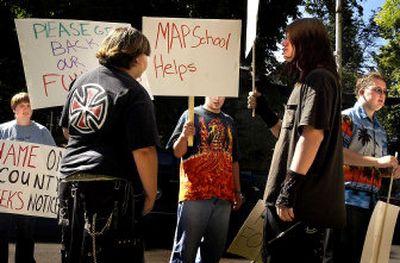
On Friday, Van Dusen joined a dozen other current and former students from MAP – an acronym for Multi-agency Adolescent Program – at a protest outside the offices of Spokane County’s public mental health administration. Last week, the county proposed shuttering two alternative schools as part of a series of drastic cuts to mental health services in Spokane.
County officials estimate the public mental health system faces a $7.5 million budget shortfall as a result of changes to federal regulations under the Bush administration, as well as a state reallocation plan that shifted funding from Washington’s three largest counties to keep other counties afloat. Spokane County has proposed cutting $450,000 a month to mental health programs serving everyone from children to the elderly.
The county loaned the Spokane mental health system $2.8 million on Thursday to cover expenses until Oct. 1.
“The county is not in the position to fund mental health,” said Marshall Farnell, the county’s chief executive. “That is a state responsibility. The dollars have to come from somewhere.”
Doug Porter, assistant secretary for the state’s Health and Recovery Services Administration, said officials in Olympia worried that as many as nine of the state’s 14 public mental health systems – known as regional support networks – would fail financially without the redistribution.
But Porter said Spokane County has overplayed the seriousness of the cuts. In a statement released this week, the Department of Social and Health Services said funding for Spokane was $525,000 more than originally forecast. Spokane County also received about $1.3 million out of the $80 million set aside by the Legislature last session to support programs previously funded by the federal government, according to the state.
“Is this enough money? Probably not,” Porter said. “But we’re bewildered as to why the cuts are being portrayed at that magnitude.”
Sen. Lisa Brown, D-Spokane, has worked to reconcile the differing analyses from state and local budget leaders, but she urged the county to be patient.
“I am calling on the county commissioners and the Regional Support Network to delay action until we have time to engage in further discussion,” Brown said in a press release Friday.
But county officials, who estimate they are losing more than $20,000 a day, said they have repeatedly asked the state and Gov. Christine Gregoire to intervene. On Friday, Porter said a state team will arrive in Spokane next week to meet with county officials.
Unlike King and Pierce counties, which also saw their proposed funding decrease during the reallocation process, Spokane County has no reserve funds to rely on until the Legislature reconvenes.
“They can’t manage through it because they are broke,” said a prominent Spokane mental health provider, who asked to remain anonymous because of the sensitivity of the issue. “How do you spend down all of your reserve?”
Porter said the state contract requires the regional systems to maintain a reserve fund.
Network administrator Edie Rice-Sauer did not immediately return a phone call on Friday.
Outside her offices, the students waved signs to passing cars and offered testimonials to the work of the staff at MAP, which has been jointly operated by Spokane Public Schools and Spokane Mental Health since it opened in 1989.
Shane Stevenson, a 16-year-old MAP student, said he suffered from severe depression and had been suicidal.
“In public school, I was pretty much a target,” he said. But at the alternative school, “everyone had their own problems and you helped each other through them.”
David Kreis, 17, said he had been taunted in public school, but welcomed by other students at MAP.
“I felt like this would be my last chance to graduate,” he said.