
Calling all kids
It’s the new rite of passage.
Not too long ago, the monumental event in a 10-year-old’s life was getting braces. Now everyone who is anyone has to have a cell phone.
Depending on who’s talking, phones for such young children are either a blessing in emergencies, the latest back-to-school accessory, noise pollution or a health risk. Or, as one concerned social worker put it, “an electronic umbilical cord” to Mom and Dad.
Now, 14 percent of children ages 10 and 11 nationwide have their own cell phones, according to GfK NOP, a market research firm.
Don’t hang up yet; the firm predicts one out of three kids that age will have their own phones within the next year or two. That’s the current rate for 12-to-14-year-olds.
Wireless companies are racing to cash in on this lucrative young market and win brand loyalty at a tender age. To boost the phones’ allure, companies are snazzing them up with all kinds of “cool” entertainment – games, graphics and ring tones. “These phones are great for 10- and 11-year-olds when they’re stuck in the back of Mom’s car when she’s at the dry cleaner’s,” says Ben Rogers, vice president of GfK NOP.
Some children’s advocates, however, say all this hoopla should be put on hold pending further study of the phones’ possible perils.
Commercial Alert, a nonprofit consumer group, recently asked Congress to investigate the safety and privacy issues surrounding the marketing of cell phones to children. The group warned that kids might be enticed to run up huge bills; advertisers might bombard kids directly via cell phones or phone-related Web sites; and predators might use phones to lure children into danger.
Targeting young children for cell phone sales “is one of the worst ideas to appear in the American economy in a long time,” Commercial Alert said in its July letter to Congress, backed by 30 prominent child advocates, psychologists and educators. “Does anyone really believe that kids today lack sufficient distractions from schoolwork, that there are insufficient disruptions in the home, and that child predators and advertisers lack sufficient means of access to kids?”
Some parents who give their children cell phones say they just want a convenient way to communicate, especially in a crisis, and they can easily revoke any phones that are misused.
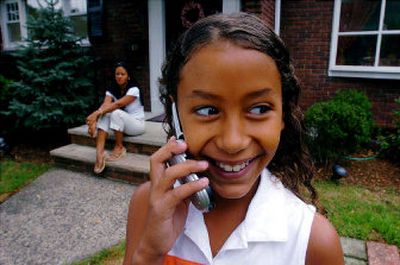
Leila Leon of Glen Rock, N.J., gave one to her daughter last Christmas when Ciena was 9 and started walking three blocks home from school. Ciena is not allowed to text-message or use the Internet through the phone. She calls friends mostly on weekends when minutes are free. “I felt she was mature enough to handle it,” says Leon. “It’s an emergency tool.”
Daniel, a 10-year-old whose last name was withheld for privacy, says his father gave him a cell phone about a year ago after his parents separated. “My dad wanted me to call him,” Daniel says sweetly. “I can call whoever I want, but I just call my dad.”
The targets of some phone companies’ pitches might be barely old enough to write down a phone number. Firefly Mobile, for example, aims for 6-year-olds and up; their phone has a big button with a symbol for a woman that speed-dials Mom and another button for Dad.
TicTalk, to be available this month, is also intended for age 6 and up and comes loaded with “educational” games by LeapFrog. Parents can program in all the numbers the child is allowed to dial or receive calls from. They also can limit the times that calls are permitted.
“Everything on the device is parent-controlled,” says Mark Weinzierl, president of Enfora, the company behind the TicTalk. “It makes the child feel safer because they have that wireless tether back to their parents … It’s like a cell phone with training wheels.”
One European agency has taken action based on a controversial warning – that children’s developing brains might be vulnerable to electromagnetic radiation from prolonged cell phone use. There is no proof of such damage, but the British National Radiological Protection Board recommended last year that parents avoid giving cell phones to children younger than 8 and that older children should use them only when absolutely necessary. The guidelines caused such a stir that MyMo, a phone marketed for children ages 4 to 8, was taken off the shelves in Britain.
Weinzierl counters that his company’s TicTalk meets all federal safety requirements and can be held in the hand, like a walkie-talkie, rather than near the ear.
Many companies are shooting for the older “tween” market of 8 to 12. Mattel has a new Barbie phone with prepaid minutes so parents can control how long their child talks. The Barbie phone also links into a “rewards board” on myscene.com, so kids can earn extra minutes by doing chores or getting good grades. (And, as the company would hope, they can check out the ads there for Barbie fashions, dolls and DVDs.)
Some critics of phones for children call the trend a bow to peer pressure and their desire for a status symbol. Gary Direnfeld, a social worker in Ontario, who writes about child development, cautions that “electronic umbilical cords” can provide a false sense of security.
“No amount of technology can compensate for judgment,” he notes. “Kids may still place themselves at risk and communication devices provide a means of assistance only after the child may have fallen prey to harm.”
Some from the old school also worry that cellphones add yet another distraction at a time when children are often overloaded with images from television, electronic games and other technologies.
Kathi Meding, executive director of the Ridgewood YMCA, bars children from bringing cellphones to summer camp. “With cellphones and text messaging, we’re losing our ability to communicate verbally, face to face,” she said. “Families look to the Y to provide traditional recreation in the outdoors. That’s what childhood is about – playing with other children.”
Across town at the U.S. Sports Institute, David Hooper, a 20-year-old coach, was surprised to see a boy playing games on his cellphone at lunch. “I never thought I’d have to tell a 10-year-old to put away a cellphone at camp,” says Hooper. “I didn’t get a cellphone until I was 16.”