
Saudis ‘addicted’ to stocks
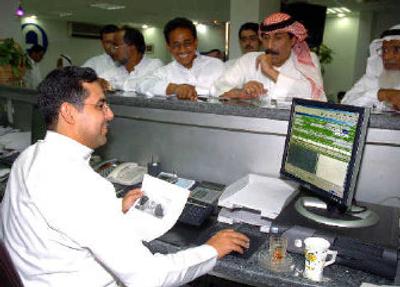
RIYADH, Saudi Arabia — So many people crush the banks to get on board an initial public offering that the police have to be called out. Some Saudis disappear from work during trading hours, and teachers bring their laptops to class to trade stocks.
Saudis have stock market mania, and the obsession is as close to gambling as one can get in a kingdom that bans it.
Five years ago, about 50,000 Saudis had dealings with the stock market. Today, there are more than 2 million active investors in a country of 26 million people.
“For some people, it’s an addiction that’s almost akin to the addiction to the casinos of Las Vegas,” said Prince Mohammed Al-Faisal, a businessman.
The index went up by 85 percent in 2004, closing at 8200 at year’s end. This year, it has grown by more than 100 percent.
The stock market run began in 1999 when an increasing number of companies began going public. But it really took off in 2003 when oil prices started climbing, eventually tripling to current levels of nearly $60 a barrel.
Oil revenues, which were at $61 billion in 1998, are expected to reach $291 billion this year and $305 billion next, said the Washington-based Institute of International Finance.
The boom not only has benefited Saudi Arabia, which has the biggest Arab economy, but other Gulf countries as well. The institute said in August that Saudi Arabia, Bahrain, United Arab Emirates, Kuwait, Oman and Qatar are in the midst of a period of exceptional economic performance.
Economists also credit the boom to a shift in strategy that prompted Gulf Arabs to pull their money out of slumping U.S. markets and invest it at home.
Before the Sept. 11 attacks, Middle Eastern oil exporters were plowing as much as $25 billion a year into U.S. investments, according to World Bank figures. In 2001-2003, however, that amount was only $1.2 billion.
The Saudi American Bank said in August that the stock market boom was fueled by “Saudi oil production, better-than-expected corporate performance, interest created by new IPOs, and high liquidity.”
“We see no deterioration on the horizon of any of these underlying forces driving the stock market,” the bank report said.
IPOs generate major excitement. On the first day of the initial public offering for stocks of YANSAB, a petrochemicals company, the crowds of potential subscribers were so huge that some banks sought police help to maintain order and break up scuffles.
Mindful of the trend, the Saudi-owned Al-Arabiya satellite TV station recently began giving daily Arab market updates, displaying scroll bars tracking stock performance and airing business programs meant to help investors.
“People are looking for information,” said station general manager Abdul-Rahman al-Rashed. “They are losing money because they have no information.”
Economists say inexperienced investors are basing their trading not on the performances of companies but on rumors of what big traders — known as “hamour,” a fish found in the Gulf — are buying that day. Most traders manage their own portfolios.
Even Saudi women, whose activities are heavily restricted, are caught up in the stock market craze.
Banks have fitted women-only halls with deep, comfortable chairs and computers. On a recent afternoon, two dozen women in one hall kept their eyes on a giant screen showing the movement of stocks as they sipped tea or cardamom-flavored coffee.
Jihan al-Kahtani, a 29-year-old university student, said she has stopped going to such places because they can be noisy and littered with leftover food.
Plus, she said, she spent much of her time filling sales orders for women investors who could not read or write.
“So now I trade on the Internet,” she said.